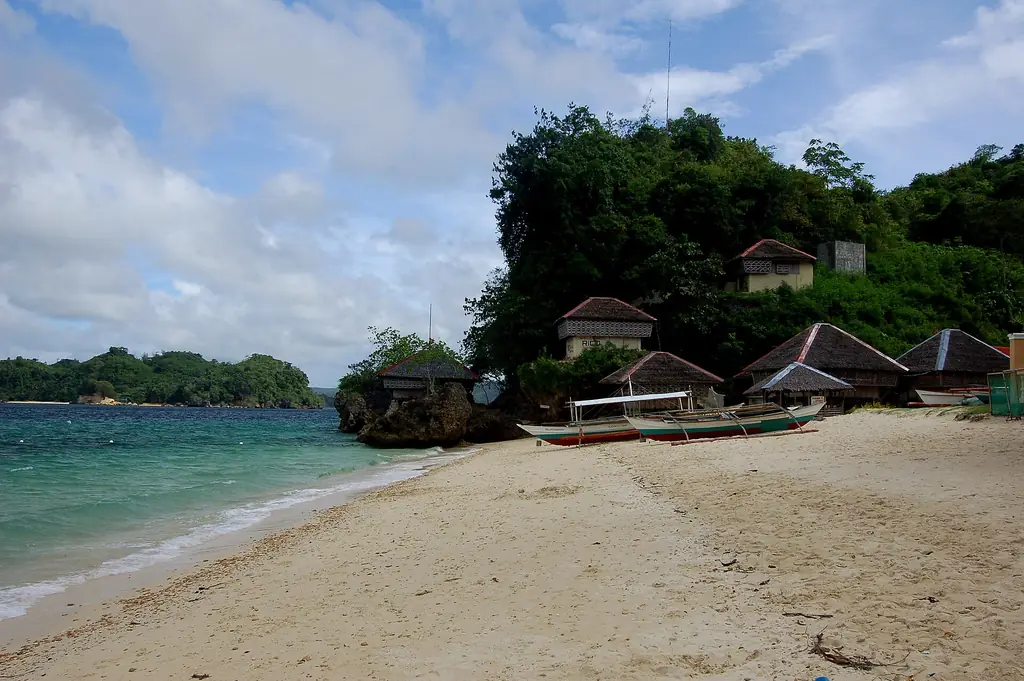
A white-sand beach at Nueva Valencia, Guimaras
Photo: paulshaffner · CC BY 2.0 · Wikimedia Commons
Map

Guimaras

Western Visayas
Visayas
Capital Jordan
Population (2024) 192,874
Area 605 km²
Municipalities 5
Cities 0
Island Group Visayas
Languages Hiligaynon, Kinaray-a

Population: 2024 census (PSA). Area: land area.

Kapitbahay — Neighboring Provinces
An island province — the sea is the only neighbor. That isolation shaped everything here.

Guimaras is a small island province in the Visayas, sitting in the strait between Panay and Negros. Nicknamed the Mango Capital of the Philippines, it is known for mangoes that many call the sweetest in the country. It was also hit by the country's worst oil spill of its time, in 2006.

JordanCapital
605 km²Area
5Municipalities
VisayasIsland Group

Jordan is the provincial capital, a small town that handles administrative functions while the nearby municipalities of Buenavista and Nueva Valencia do more of the agricultural work. The island is easily reached from Iloilo City by a ferry crossing of 15 to 20 minutes.

★
The Sweetest Mango

The Carabao mango grown in Guimaras is prized for its sweetness, and Guimaras mangoes have been served at the White House and Buckingham Palace. About half of the country's exported mangoes are said to come from the island.

The province became its own entity in 1992, having been a sub-province of Iloilo since 1966. Its small size and proximity to Iloilo City mean it remains closely integrated with the Iloilo economy, but it has developed its own institutional identity and a tourism profile built around its beaches, mangroves, and mango farms.

The 2024 census counted 192,874 people in Guimaras. The province is Guimaras Island and many islets, among them Inampulugan, Guiwanon, Panobolon, Natunga and Nadulao, with a land area of about 605 square kilometers. Buenavista is the largest of its five municipalities, and the island's highest point, Mount Bontoc, is only about 272 meters high.

Guimaras was populated before Spanish contact as part of the broader Visayan maritime world. Its old name was Himal-os. Spanish missionaries arrived in the late sixteenth century, and the island was long administered from Oton and Iloilo.

1581

Spanish Settlement

About 1581, Governor-General Gonzalo Ronquillo de Peñalosa set up a settlement on the island, then called Himal-os, and the Augustinians organized the villages of Nayup and Igang as chapelries of Oton in Iloilo.

1945

Battle of Guimaras

On 19 March 1945, American and Philippine Commonwealth forces landed on Guimaras and Inampulugan islands and defeated the Japanese garrison.

1966

Sub-province of Iloilo

Republic Act No. 4667, enacted on 18 June 1966, made Guimaras a sub-province of Iloilo.

1992

A Full Province

After a plebiscite held under Section 462 of the Local Government Code, Guimaras became a regular province in May 1992, with Jordan as its capital. Sibunag and San Lorenzo were created as new towns in 1995.

August 2006

Solar 1 Oil Spill

The tanker Solar 1, chartered by Petron and carrying about 2.4 million liters of bunker fuel, sank about 17 kilometers off the island's southern coast on 11 August 2006. The Coast Guard called it the worst oil spill in the country's history at the time; about 1,100 hectares of mangroves were affected, including parts of the Taklong Island National Marine Reserve.

The Solar 1 spill was a turning point. Recovery took years, and the disaster drew national attention to the risks that shipping poses to small island economies.

Guimaras shares its cultural foundations with Iloilo — the province speaks Hiligaynon, practices folk Catholicism with the same intensity found across Western Visayas, and maintains the same cycle of fiesta, planting, and harvest that organizes rural life on Panay.

The Manggahan Festival

Dancers in mango-coloured costumes at the Manggahan Festival, Guimaras
Photo: EMMAN A. FORONDA · CC BY-SA 4.0 · Wikimedia Commons

The Manggahan Festival, held every May during the mango season, is Guimaras's biggest celebration. Locals in mango-inspired costumes parade mango-themed floats around the island, and mango pastries and fresh fruit are sold everywhere. Its dance contingent won the Kasadyahan Festival in Iloilo City in 2018.

★
Post-Spill Cultural Memory

The 2006 oil spill is remembered in Guimaras through oral history and local journalism. Fishing families still describe which fishing grounds closed and for how long.

The Trappist monastery near the center of the island draws visitors to its retreat house and shop, where mango products made to support the monks are sold. Navalas Church, built between 1880 and 1885, is one of the few Spanish-era churches left on the island, and pilgrims climb to the Balaan Bukid Shrine during Holy Week.

See the great festivals in Pista ng Pilipinas →

Mango is the lens through which Guimaras food culture is understood, but the province has a broader table — seafood from its coasts and the strait, rice from its flat interior farmland, and the Ilonggo cooking tradition it shares with Iloilo.

Guimaras mangoes for sale along the Circumferential Road, Jordan
Photo: Patrickroque01 · CC BY-SA 4.0 · Wikimedia Commons

Fresh Guimaras Mango

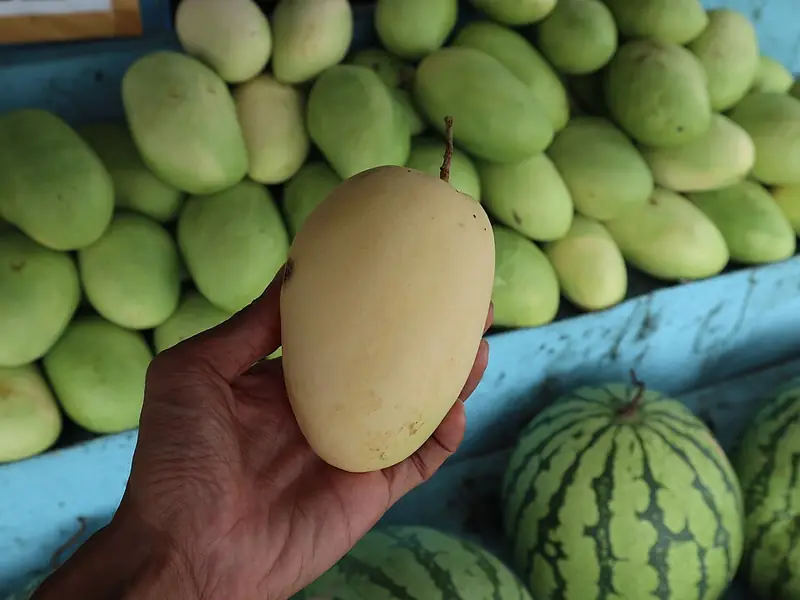
The ripe Carabao mango of Guimaras is yellow, smooth and very sweet. The proper way to eat it is to score the flesh while in the skin, invert the halves, and eat directly. No accompaniment is needed or recommended.

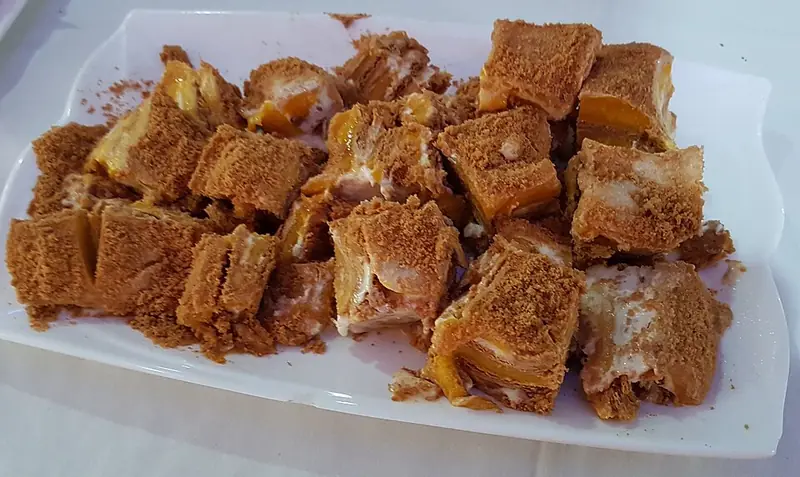
Mango float: layers of graham crackers, cream and mango
Photo: Obsidian Soul · CC0 · Wikimedia Commons

Mango Float

Layers of graham crackers, whipped cream, and sliced Guimaras mango, refrigerated until set. A simple no-bake dessert made elaborate by the quality of the mango. Found in every bakeshop and restaurant on the island.

Inday-Inday

Guimaras / Western Visayas
10 minutesPrep
20 minutesCook
6Serves
Ingredients
  • 2 cupsglutinous rice flour
  • 1 cupcoconut milk
  • ½ cupsugar
  • ½ cupwater
  • 1 cupfresh grated coconut for topping
  • pinchsalt
Method
  1. Mix glutinous rice flour, coconut milk, sugar, water, and salt into a smooth batter.
  2. Pour into a greased baking dish or individual molds.
  3. Steam for 15–20 minutes until set and slightly translucent.
  4. Allow to cool slightly before unmolding.
  5. Top with freshly grated coconut.
  6. Serve warm or at room temperature.
Cook's note

Inday-inday is a rice cake found across Western Visayas under various names. The texture should be soft and slightly chewy, not rubbery. Do not overbake — steam just until set. Fresh coconut grated the same day is far superior to desiccated coconut.

Grilled Squid with Green Mango Salad

A Guimaras combination that makes use of both the seafood of the strait and the province's unripe mangoes. Green mango is julienned and dressed with bagoong, chili, and calamansi — a sharp, salty counterpoint to the sweetness of grilled squid.

Hiligaynon — the language of Iloilo and the broader Western Visayas — is the primary language of Guimaras. Given the island's historical and geographic integration with Iloilo, this is unsurprising. The same vocabulary, the same cadences, the same songs.

Hiligaynon (Ilonggo)Primary Language
~9 million (Western Visayas)Speakers
Austronesian / BisayanLanguage Family
Western Visayas (Region VI)Region

Hiligaynon is often described as a gentle-sounding language. It has a significant literary tradition including the Ilonggo awit and corrido, narrative poem forms adapted from Spanish colonial literary models.

Kinaray-a, the language of Antique and inland Iloilo, is also spoken by some families in Guimaras. It is considered a distinct language rather than a dialect of Hiligaynon, though the two are related and share vocabulary.

Guimaras is one of the most accessible island provinces in the Philippines. Ferries from the Iloilo–Guimaras Ferry Terminal in Iloilo City reach Jordan and Buenavista in 15 to 20 minutes, and roll-on/roll-off ships sail from Lapuz. A ferry also links Sibunag with Pulupandan in Negros Occidental.

15–20 minutes (to Jordan)Ferry from Iloilo City
RoRo from Lapuz, Iloilo CityAlso
Sibunag–Pulupandan ferryTo Negros
Iloilo International AirportNearest Airport

Alubihod Beach

One of the island's popular beaches, with calm water. Cottages available for day use. The beach is popular with Iloilo families on weekends. Quieter on weekdays.

McLaren Mango Farm

A commercial mango farm open to visitors during the harvest season (March to June). Tours show the cultivation process — the grafting, the bagging of developing fruit to protect it from insects, the harvest itself. The farm store sells fresh mangoes, mango jam, and dried mango products.

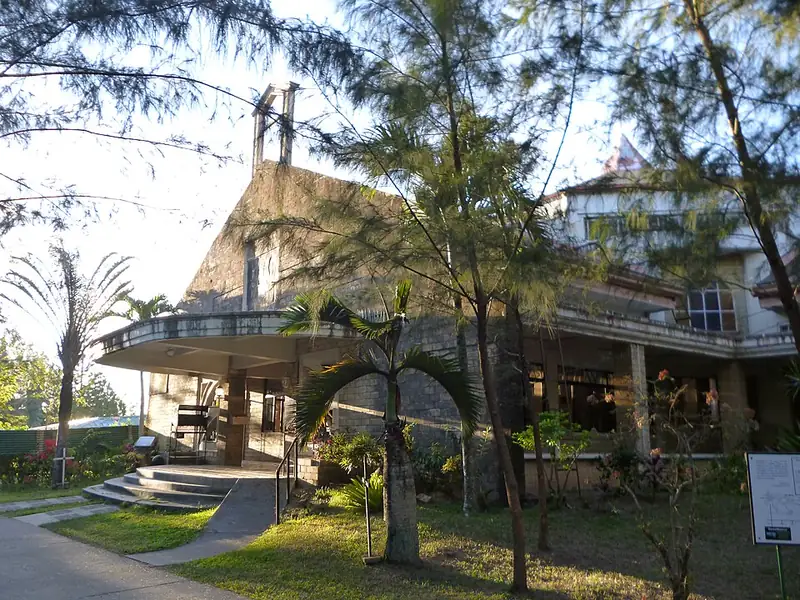
The church of the Trappist monastery in Jordan, Guimaras
Photo: Iloilo Wanderer · CC BY-SA 3.0 · Wikimedia Commons

Our Lady of the Philippines Trappist Monastery

A Cistercian (Trappist) monastery near the center of the island. Visitors are welcome at its retreat house and shop, which sells mango-based foods that help support the monks. The chapel is open for prayer. A quiet place in a province that is mostly quiet.

✦
Mango Timing

Guimaras mangoes peak in March through May. Outside of this season, mangoes are available but the selection and quality are lower. If visiting specifically for the mango experience — farm tours, Manggahan Festival — plan for April or May.

Guimaras is low and hilly, its highest point only about 272 meters, and its rivers are short; the Sibunag River, the longest, runs 28.8 kilometers. Its richest habitats are on the coast. Off the southern tip, Taklong Island in Nueva Valencia is the main island of the Taklong and Tandog Group of Islands Natural Park, formerly the Taklong Island National Marine Reserve, where the University of the Philippines Visayas has run a marine station since 1977. About 1,100 hectares of mangroves were affected by the 2006 oil spill; on Taklong, 90 percent of the mangrove forest was coated with oil, and after rehabilitation began in 2007 it has recovered.

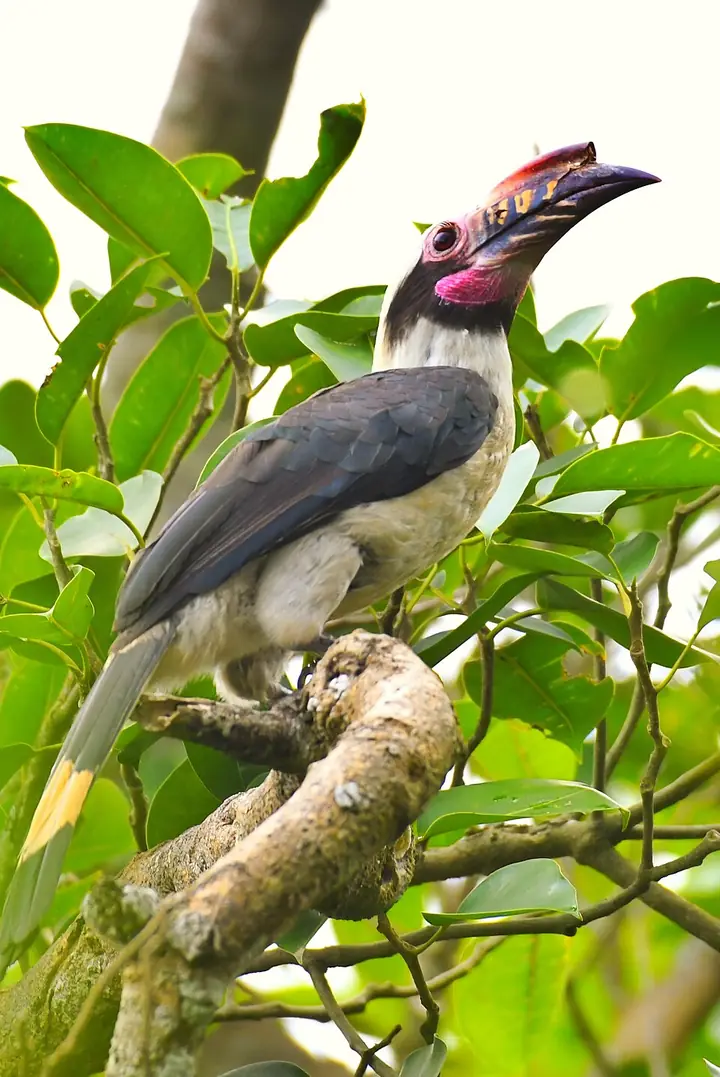
A Visayan tarictic hornbill (location not recorded)
Photo: Ranieljosecastaneda · CC BY-SA 4.0 · Wikimedia Commons
Visayan Tarictic Hornbill
Penelopides panini
Endangered
A small hornbill of the lowland forests of the western Visayas. The nominate race is found on Panay, Negros, Masbate and Guimaras, but forest clearing has made it rare.
Field note: Hornbills nest in big old trees. Never buy wild hornbills.
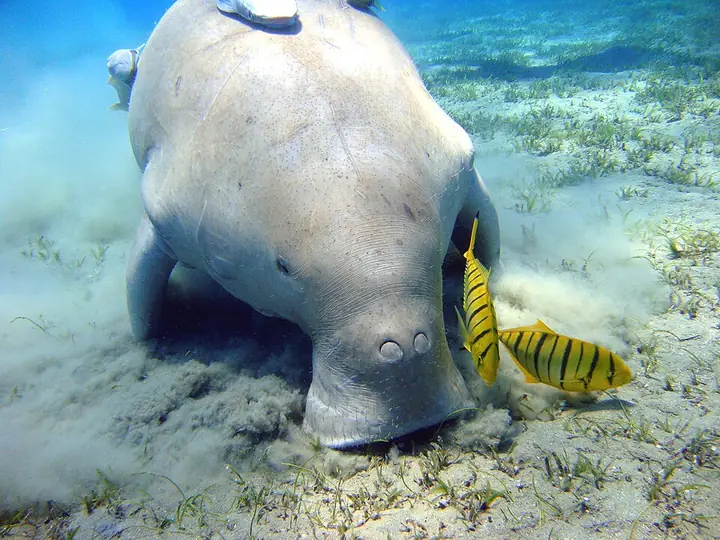
A dugong grazing on seagrass (photographed in the Red Sea, Egypt)
Photo: Julien Willem · CC BY-SA 3.0 · Wikimedia Commons
Dugong
Dugong dugon
Vulnerable
A sea mammal that grazes on seagrass. Hunting, drowning in fishing gear and the loss of seagrass meadows have left only isolated populations in the Philippines, and Guimaras is one of the places where they still survive. It was the first marine animal protected by Philippine law.
Field note: Slow boats over seagrass, and report any stranded or tangled dugong to local authorities.
Meet all 65 Philippine animals in Hayop ng Pilipinas →

On 11 August 2006 the 998-ton tanker Solar 1, chartered by Petron, sank about 17 kilometers off the southern coast of Guimaras. It was carrying about 2.4 million liters of bunker fuel, and the oil contaminated about 24 square kilometers of sea and long stretches of coast.

The Philippine Coast Guard called it the worst oil spill in the country's history at the time. Officials said about 1,100 hectares of mangroves were affected, including parts of the Taklong Island National Marine Reserve. Fishing families, whose income depended on the sea, watched their grounds turn black.

What the spill revealed about Guimaras was the thinness of the margin on which its economy operated. The province had no diversified industrial base to absorb the loss of fishing income. The mango farms — in the interior and not directly touched by the oil — continued producing. But the coastal communities, which had no mangoes, had nothing.

Recovery took years. Today the province promotes the same coast for ecotourism: Taklong Island off the south coast, and beaches such as Guisi, Alubihod, Tatlong Pulo and Natago.

Sources · updated 4 October 2026
Photo credits (7)

Photos from Wikimedia Commons, used under the licences shown; some were resized. All photo credits