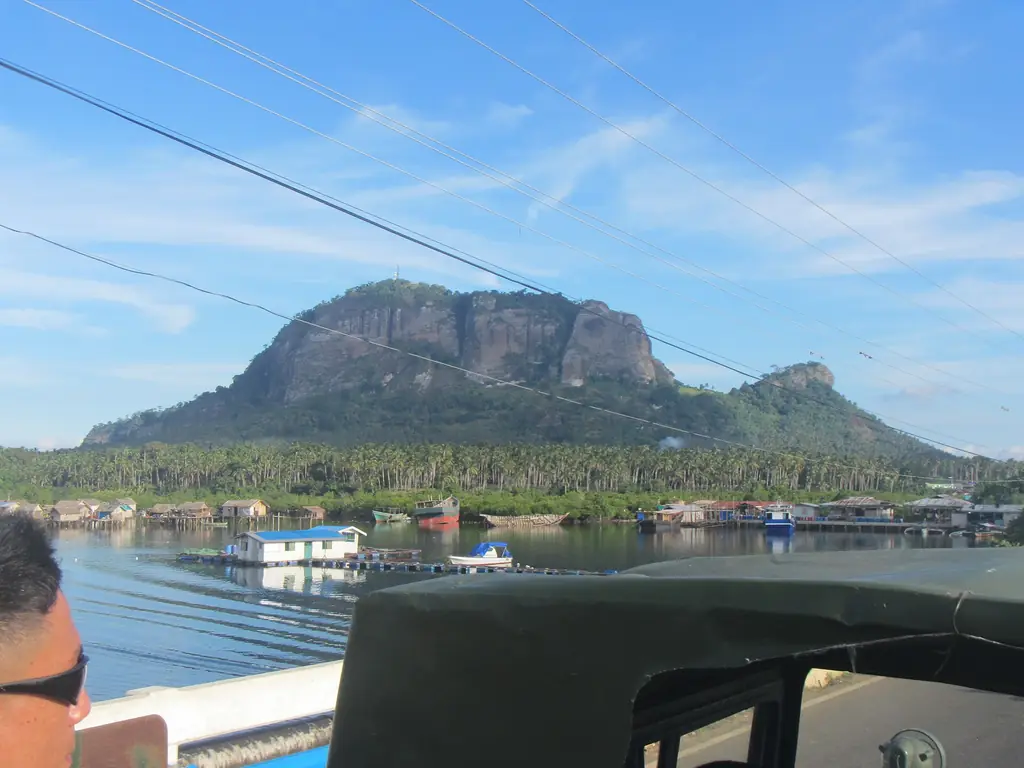
Bud Bongao, the peak above Bongao, Tawi-Tawi
Photo: Ervin Malicdem · CC BY-SA 4.0 · Wikimedia Commons
Map

Tawi-Tawi

BARMM
Mindanao
Capital Bongao
Population (2024) 482,645
Area 1,087 km²
Municipalities 11
Cities 0
Island Group Mindanao
Languages Tausug, Sinama, Filipino

Population: 2024 census (PSA). Area: land area.

Kapitbahay — Neighboring Provinces
An island province — the sea is the only neighbor. That isolation shaped everything here.

Tawi-Tawi is the southernmost province of the Philippines — Tawi-Tawi Island and 106 smaller islands and islets at the end of the Sulu Archipelago, closer to Malaysia's Sabah coast than to Manila. It faces the Celebes Sea to the south and the Sulu Sea to the north, and its southernmost island, Sibutu, is separated from Borneo by a narrow strait.

BongaoCapital
1,087 km²Area
11Municipalities
MindanaoIsland Group

The Sama-Bajau people — the sea nomads of maritime Southeast Asia — are the dominant cultural group of Tawi-Tawi. The Bajau Laut (Sama Dilaut), as they are called, have lived on boats or stilt houses over the water for centuries, maintaining a maritime culture that is one of the most distinctive in the world. Their numbers in the province are falling as families move to other parts of the Philippines, Malaysia and Indonesia.

★
The Peoples of Tawi-Tawi

Most people in Tawi-Tawi are Sama, named after their home islands: Sama Sibutu, Sama Simunul, Sama Kapoan and others. The Jama Mapun live mainly in Mapun and the Turtle Islands, and the Tausug are a large minority.

The 2024 census counted 482,645 people in Tawi-Tawi. Its 11 municipalities cover Tawi-Tawi Island, which is a little more than half of the province's 1,087 square kilometers, and the island groups around it: Sibutu and Sitangkai in the far south, Simunul, Mapun close to Palawan, and the Turtle Islands near Sabah. The name is the Sinama form of jawi-jawi, the Malay word for the banyan tree.
At the Edge of the Sultanate

Tawi-Tawi's islands were within the sphere of influence of the Sulu Sultanate — the archipelago's southernmost extension of the sultanate's maritime network. The Sama and Bajau peoples who inhabited the islands were not exactly subjects of the sultanate but existed in a relationship of mutual benefit and occasional tension: the sultanate provided protection and trade access, the sea peoples provided labor, fish, and maritime intelligence.

1380

The First Mosque

According to local tradition, the Arab missionary Sheikh Karim ul-Makhdum built a mosque at Tubig Indangan on Simunul in 1380. It is regarded as the oldest mosque in the Philippines and is a National Historical Landmark.

1878

Sabah Leased to the British

On 22 January 1878 the Sultan of Sulu, whose realm included the Tawi-Tawi islands, signed a treaty leasing his lands in northern Borneo to Baron von Overbeck of what became the British North Borneo Company, for an annual payment of 5,000 Mexican dollars.

1900

Sibutu Joins the Philippines

Under the 1900 Treaty of Washington, Spain ceded Sibutu and Cagayan de Sulu (now Mapun), which had been left out of the 1898 Treaty of Paris, to the United States for US$100,000.

1945

Liberation at Sanga-Sanga

During World War II the Japanese Navy used the waters off Tawi-Tawi as a fleet anchorage. Guerrillas of the Sulu Command helped American forces land at Sanga-Sanga Island on 2 April 1945.

1973

Tawi-Tawi Becomes a Province

Presidential Decree No. 302 of 11 September 1973 separated Tawi-Tawi from Sulu. The capital was first at Bato-Bato in Balimbing (now Panglima Sugala) and moved to Bongao on 4 April 1979 by Batas Pambansa Blg. 24.

2019

Part of BARMM

After the ratification of the Bangsamoro Organic Law in 2019, Tawi-Tawi became part of the Bangsamoro Autonomous Region in Muslim Mindanao.

Tawi-Tawi's culture is maritime Islamic at its core. The Sama-Bajau communities — both the land-dwelling Sama and the boat-dwelling Bajau Laut — maintain traditions of music, weaving, and boat-building that represent some of the oldest surviving material culture of maritime Southeast Asia. The province is the living center of the Sama musical tradition.

The Kulintang of Tawi-Tawi

The Sama of Tawi-Tawi share in the gong-ensemble music of the southern Philippines, played at weddings and celebrations. Some islands also keep centuries-old burial grounds with traditional Sama okil carvings of ancestors.

Pangalay Dance — Tawi-Tawi Style

The pangalay, a dance of slow, flowing hand and wrist movements, is performed across the Sulu Archipelago, and Tawi-Tawi's dancers and schools keep it alive at weddings and festivals.

★
Bajau Boat Building

The lepa — the traditional houseboats of the Bajau Laut — are built without nails using woodworking techniques passed through generations of boat-builders. The lepa is not just a vessel but a home, a symbol of identity, and a demonstration of craftsmanship.

See the great festivals in Pista ng Pilipinas →

Most of Tawi-Tawi is Muslim, so everyday food is halal and pork is rarely served. The sea provides the primary protein: the rich fisheries of the Sulu and Celebes Seas deliver an extraordinary variety of reef and pelagic fish, with tuna, grouper, snapper, and shellfish forming the base of everyday cooking. Its cooking shares much with the Malay world across the border.

Tiyula Itum (Sama Version)

The black soup of the Tausug and Sama traditions — dark, smoky, built on burned coconut and local spice. The Sama version in Tawi-Tawi uses reef fish rather than the beef or chicken of the Sulu mainland version. The burned coconut base gives the broth its characteristic dark color and the smoky depth that defines the dish. A royal dish, served at celebrations.

Piaran (Sama Fish Curry)

Fresh fish cooked in coconut milk with turmeric, lemongrass, ginger, and local spice. The Sama version in Tawi-Tawi is closer in composition to the Malaysian ikan masak lemak than to any other Philippine fish preparation — a reflection of the historical connections between the Sama world and the Malay archipelago. Served with steamed rice and pickled vegetables.

✦
Bongao Market

Bongao's waterfront market — active from before dawn — is the best introduction to Tawi-Tawi's food culture. The variety of fresh seafood reflects the province's position at the junction of the Sulu and Celebes Seas. The cooked food stalls around the market serve halal breakfast from early morning: fish, rice, and strong black coffee.

Tausug is the common language of Tawi-Tawi, as across the Sulu Archipelago. Sinama, the language of the Sama, is spoken in several varieties: Sinama Sibutu, Sinama Simunul, Sinama Kapoan and Sinama Banguingui. Chavacano, Cebuano and Yakan are also heard, and many traders speak Sabah Malay. Arabic is used in religious contexts — the mosques, the madrasas, and the Quranic recitation that marks daily life across the province.

TausugCommon language
Sinama (several varieties)Sama
Jama MapunMapun
Sabah Malay, Chavacano, CebuanoAlso

Sinama — The Sea Language

Sinama belongs to the Sama-Bajau languages, a branch of the Austronesian family spoken by sea-oriented communities across the southern Philippines, Sabah and eastern Indonesia.

★
A Language Across Borders

Sinama is spoken not only in Tawi-Tawi and the Sulu Archipelago but also in parts of Malaysia's Sabah, Indonesian Sulawesi, and the island communities of Borneo. The Sama-Bajau linguistic community is one of the most geographically dispersed in Southeast Asia — the same language family connects communities from the Philippines to Indonesia across thousands of kilometers of sea.

Tawi-Tawi is reached by air from Zamboanga City — a flight of about one hour to Sanga-Sanga Airport near Bongao. Check current travel advisories before you go.

~1 hr (air)From Zamboanga
Sanga-Sanga Airport (Bongao)Airport
Check before travelTravel advisory
BARMMRegion

Bongao Peak

Bud Bongao, 342 meters high, is a sacred mountain of six limestone peaks inside a 250-hectare forest park, one of the last moist forests in the Sulu Archipelago. Two followers of Karim ul-Makhdum are believed to be buried at its Tampat Rocks. A 3,608-step trail climbs to a view deck over the Celebes Sea.

Simunul Island

The site of the Sheikh Karimul Makhdum Mosque in Tubig Indangan, which local tradition dates to 1380, making it the oldest mosque in the Philippines. The present building dates from the 1960s, after the old one burned in 1941, but four wooden pillars inside date from the 17th century.

Tandubas Island

One of the inhabited islands of Tawi-Tawi with white sand beaches and clear water — one of the quieter island municipalities of the province. Reached by boat from Bongao. The island community is Sama.

✦
Visiting Tawi-Tawi Responsibly

Travel to Tawi-Tawi without a local contact or established community connection is not recommended. Researchers, journalists, and travelers with genuine purpose are welcomed by the Bongao community. The Provincial Tourism Office can provide guidance on current conditions and appropriate protocols for visiting island communities.

Tawi-Tawi lies where the Sulu Sea meets the Celebes Sea. Tawi-Tawi Island has birds found nowhere else, among them the Tawitawi brown dove and the Sulu hornbill, but forest clearing has left many of them threatened. Bud Bongao's 250-hectare forest is one of the last moist forests in the Sulu Archipelago. Far to the northwest, the Turtle Islands Wildlife Sanctuary protects six islands and about 243,000 hectares of sea on the Malaysian border, where green and hawksbill turtles nest; Baguan Island alone has about 63 percent of the nests.

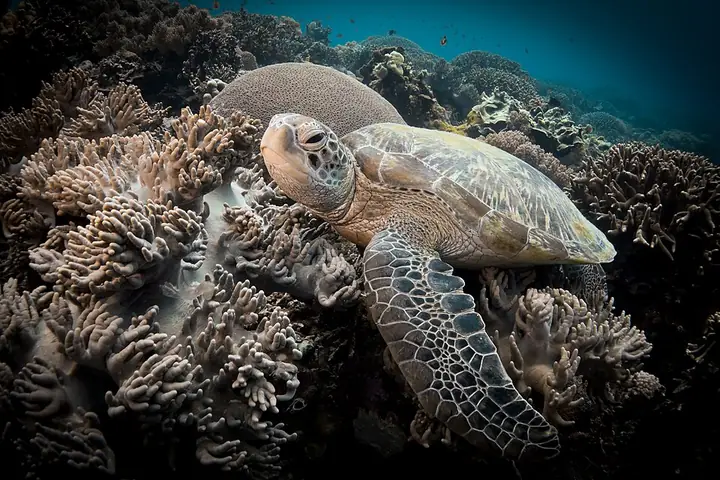
A green sea turtle over coral at Apo Island
Photo: Anna Varona · CC BY 4.0 · Wikimedia Commons
Green Sea Turtle
Chelonia mydas
Least Concern
The Turtle Islands of Tawi-Tawi are one of the most important green sea turtle nesting sites in Southeast Asia. Turtles return each year to lay eggs on the same beaches. The islands are a protected sanctuary shared with Malaysia. After decades of conservation work, the IUCN Red List moved the species from Endangered to Least Concern worldwide in October 2025.
Field note: Never disturb nesting turtles or dig for eggs. Egg collection is controlled by law and by the sanctuary agreement.
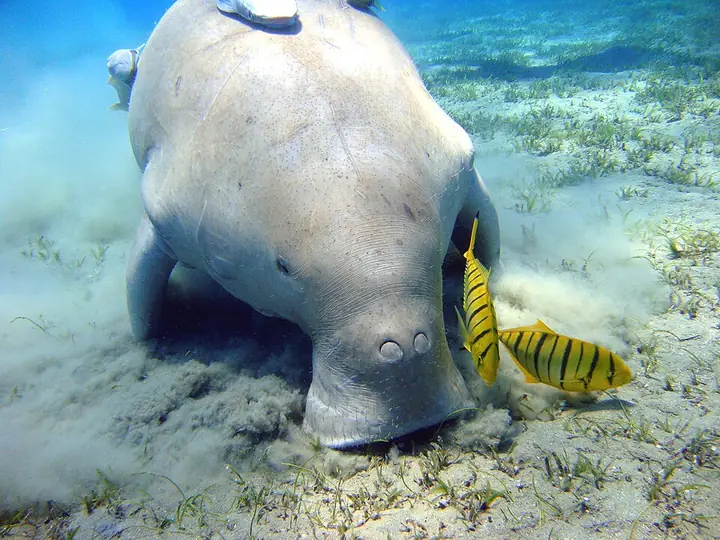
A dugong grazing on seagrass (photographed in the Red Sea, Egypt)
Photo: Julien Willem · CC BY-SA 3.0 · Wikimedia Commons
Dugong
Dugong dugon
Vulnerable
The seagrass beds of Tawi-Tawi support dugong, the gentle sea mammal that many believe inspired old mermaid stories. Healthy seagrass is the key to their survival.
Field note: Slow boats over seagrass. Report any stranded or hurt dugong to local authorities.
Tawitawi Brown Dove
Phapitreron cinereiceps
Endangered
A forest dove with an orange-peach breast, found only on Tawi-Tawi and Sanga-Sanga. The IUCN estimates 500 to 2,500 mature birds; logging, mining and clearing for farms are the main threats.
Field note: Keep remaining forest standing. Do not trap or keep wild doves.
Sulu Hornbill
Anthracoceros montani
Critically Endangered
A black hornbill now found only on Tawi-Tawi; it was hunted out of Jolo by the 1930s. A 2019 estimate put the wild population at only about 27 mature birds, though the figure is uncertain.
Field note: Hornbills need very large trees to nest. Never buy or keep hornbills.
Meet all 65 Philippine animals in Hayop ng Pilipinas →

The Oldest Mosque

According to local tradition, in 1380, more than a century before Magellan reached the islands, an Arab trader and Sufi scholar named Sheikh Karim ul-Makhdum arrived at Simunul in what is now Tawi-Tawi and built a mosque. It is regarded as the first mosque in the Philippine archipelago.

The original mosque was probably built in the pagoda-like style of old Moro mosques. Most of a later building burned in 1941, during the Japanese occupation, and the present domed mosque dates from the 1960s. Four old wooden pillars kept inside have been dated by the National Museum to the 17th century, making them the oldest known Islamic artifacts in the country. Islam reached the islands from the south, with traders and missionaries from Arabia, Persia, India, China and Malacca, long before the Spanish arrived.

The mosque is a National Historical Landmark and a National Cultural Treasure, and the National Historical Commission unveiled a new marker there in November 2023. Some scholars and local leaders have proposed rebuilding it in the traditional Moro style.

Sources · updated 4 October 2026
Photo credits (3)

Photos from Wikimedia Commons, used under the licences shown; some were resized. All photo credits