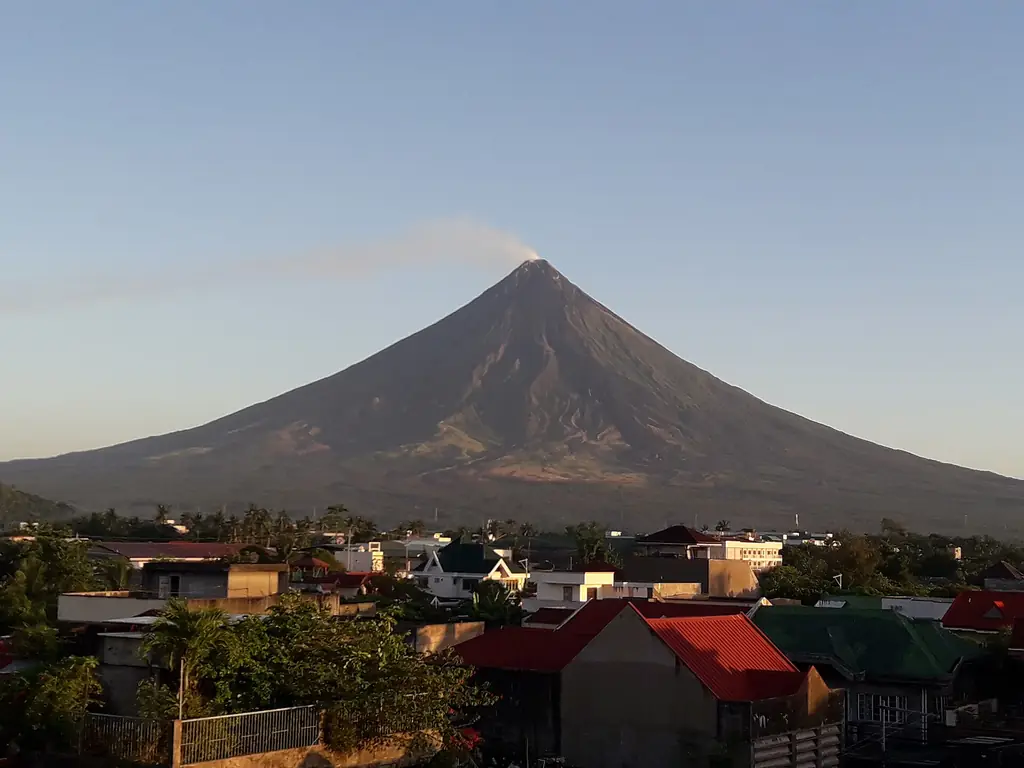
Albay is a province in the Bicol region of southern Luzon, and it is defined by a mountain that does not appear on maps as a threat but behaves as one. Mayon Volcano rises from the middle of the province with geometric precision — a near-perfect cone 2,463 meters high that has erupted more than 52 times in the past 500 years.
Legazpi CityCapital
2,576 km²Area
15 + 3 citiesMunicipalities
LuzonIsland Group
Legazpi City sits on Albay Gulf in the southern foothills of the volcano, looking up. On a clear day the cone is plainly visible from the city. It is one of the more striking urban landscapes in the Philippines — a city arranged around the fact of a volcano.
★
Most Active Volcano
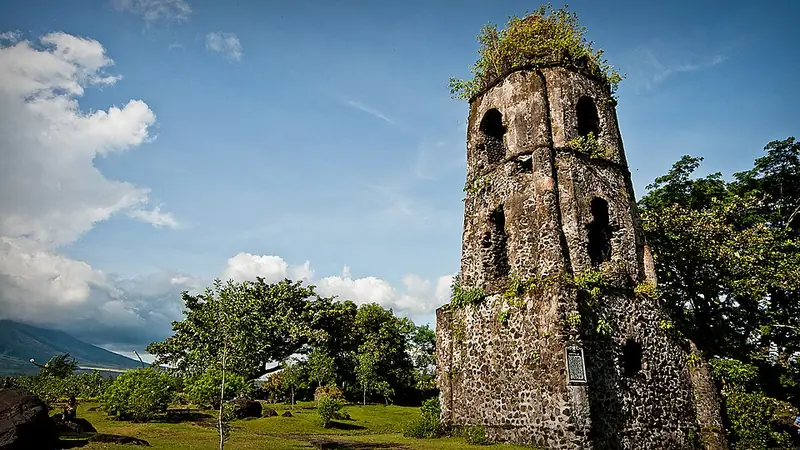
Mayon is the most active volcano in the Philippines, with more than 52 eruptions in the past 500 years; the first recorded one was in 1616. Its most destructive recorded eruption, on 1 February 1814, buried the town of Cagsawa in tephra and lahar and killed about 1,200 people. The church ruins are still visible.
The province grows abaca (Manila hemp), a very strong natural fiber and historically one of the Philippines' most important exports. It also grows rice, coconuts, and the small, intensely hot bicolano chili. Albay food is not shy about heat.
The 2024 census counted 1,379,398 people in Albay's 15 municipalities and three cities: Legazpi, Ligao and Tabaco. Legazpi is the provincial capital, the largest city and the regional center of the whole Bicol Region. In March 2016 about 250,000 hectares of the province were added to UNESCO's World Network of Biosphere Reserves as the Albay Biosphere Reserve.
Albay was once called Ibat, then Libog, and was ruled by Gat Ibal, a chief who founded the old settlement of Sawangan, now part of Legazpi. The Spanish organized the Bicol region in the late 16th century. The province has been shaped repeatedly by Mayon's eruptions — whole towns relocated, farmland buried, evacuation orders issued and then forgotten as people returned.
1569–1636
Ibalon
Spanish soldiers under Luis Enríquez de Guzmán crossed from Burias and Ticao in 1569 and landed at a settlement called Ibalon in today's Sorsogon. The Bicol peninsula was first run as one province with two parts, Camarines and Ibalon, and in 1636 Ibalon became a separate province with Sorsogon as its capital.
1616
First Recorded Eruption of Mayon
Mayon's first recorded eruption dates to 1616. It has erupted more than 52 times in the past 500 years.
1 February 1814
Cagsawa Eruption
Mayon's most destructive recorded eruption buried the town of Cagsawa and the surrounding area in tephra and lahar. About 1,200 people died, according to PHIVOLCS, many of them in the church where they had taken shelter. Only the ruins of the church and its belfry remain.
1846
Masbate Separated
A decree of Governor-General Narciso Clavería separated Masbate, Ticao and Burias from Albay to form the comandancia of Masbate.
1948–1959
Legazpi Becomes a City
Republic Act No. 306 of 18 July 1948 merged Legazpi and Daraga into a chartered city. It was dissolved in 1954 and re-established by Republic Act No. 2234 on 12 June 1959, the charter that still applies.
1984 and 1993
Evacuations and Loss
More than 73,000 people were evacuated during the 1984 eruption and no one died. In 1993, pyroclastic flows killed 79 people, mostly farmers, and about 50,000 residents were evacuated.
2016
UNESCO Biosphere Reserve
About 250,000 hectares of Albay were added to UNESCO's World Network of Biosphere Reserves in March 2016.
The tension between Mayon's danger and its rich volcanic soil has defined the human history of Albay. Farmers return to the slopes after eruptions because the volcanic land is fertile.
Bicolanos are known for their directness and their tolerance for heat — both the climatic kind, in a region that catches typhoons with regularity, and the culinary kind. Albay sits in the typhoon belt, facing the Pacific storms that regularly cross the Bicol peninsula.
The Cagsawa Ruins
The ruins of the Cagsawa church are the most visited site in Albay outside Legazpi. The belfry of the 16th-century Franciscan church, rebuilt in 1724, stands in a park with Mayon in the background and is one of the most photographed sights in Philippine tourism. The National Museum and the town of Daraga look after the site. The ruins are a reminder that the volcano has destroyed communities before and will again.
★
Abaca Capital
Albay is historically one of the Philippines' primary abaca-producing provinces. Abaca fiber — derived from the leaf stalks of a banana relative — is used for rope, twine, tea bags, and high-grade paper. It is valued for its strength and its resistance to salt water.
Bicolano Identity
The Bicolano identity spans several provinces but is expressed strongly in Albay. Bikol is not one language but several, and Albay is home to more of them than any other province. Bicolano oral literature, including the epic Ibalong, is one of the earliest recorded indigenous literary works in the Philippines.
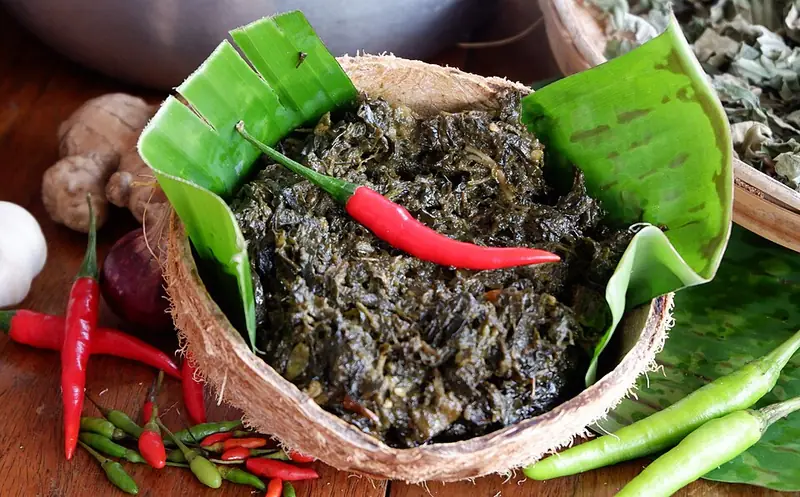
Bicolano food from Albay is built on coconut milk and chili. These two ingredients appear in almost every savory dish. The heat level is not performative — it is structural. Remove the chili and the dish changes its character fundamentally.
Dried taro leaves slow-cooked in coconut milk with pork or shrimp, chili, and shrimp paste. The dish is cooked without stirring — the cream must not break. When done correctly, the taro leaves absorb the coconut milk completely and the result is dense, rich, and very hot.
Bicol Express
Pork, shrimp paste, and small green chilies cooked in coconut cream. The dish takes its name from the Bicol Express train between Manila and Bicol. It is now known across the Philippines.
Laing
Albay / Bicol Region
10 minutesPrep
45 minutesCook
6Serves
Ingredients
200g, crumbleddried taro leaves
2 cupscoconut milk
1 cupcoconut cream
200g, sliced thinpork belly
3 tbspdried shrimp or bagoong
8–12 pieces, wholesmall green chilies (siling labuyo)
6 cloves, mincedgarlic
1 medium, slicedonion
1-inch knob, mincedginger
Method
Lay the dried taro leaves in the bottom of a wide pan. Do not stir them once cooking begins.
Add pork belly, garlic, onion, ginger, bagoong, and chilies over the leaves.
Pour coconut milk over everything. Bring to a simmer over medium heat.
Cook uncovered for 30–35 minutes without stirring, until most of the liquid is absorbed.
Pour coconut cream over the top. Continue cooking for 10 more minutes until the cream thickens and the oil begins to separate.
Serve with rice. The leaves should be tender and fully saturated.
Cook's note
Do not use fresh taro leaves — they contain irritating crystals that require the drying process to neutralize. Do not stir the laing during cooking.
Albay is home to several Bikol languages, part of the Central Philippine branch of Austronesian languages. In Legazpi, Tabaco and the eastern towns people speak the Tabaco–Legazpi–Sorsogon dialect of Central Bikol. In the west, the Albay Bikol languages (West Miraya, East Miraya and Libon) are spoken, and Rinconada Bikol is used in barangays of Libon and Polangui near Camarines Sur.
Central BikolLegazpi and east
Albay Bikol (Miraya, Libon)West
Rinconada BikolAlso
Filipino, EnglishOfficial
★
The Ibalong Epic
The Ibalong is a Bicolano epic poem, fragments of which were preserved by a Spanish friar in the 19th century. It recounts the deeds of three heroes — Baltog, Handyong, and Bantong — who cleared the Bicol land of monsters and established civilization. It is one of the few pre-colonial literary works surviving in recorded form from the Philippines.
Tagalog and Filipino are widely understood and used, particularly in Legazpi City and among younger generations. The influence of Manila-based media has accelerated Tagalog use in urban areas. In rural municipalities, Bikol remains the primary home language.
English is standard in education, and Legazpi's position as a regional commercial center means that inter-regional communication happens regularly in Filipino or English. The Bicolano tendency to mix Bikol and Filipino in conversation produces a local speech pattern called Bikol-Filipino that is instantly recognizable.
Albay is accessible and rewarding for travelers with an interest in both natural spectacle and cultural depth. Mayon dominates the experience, but the province has coastline, ruins, underground rivers, and food that justify longer stays.
Bicol International Airport, DaragaAirport
1 hr by air or ~9 hrs by busFrom Manila
February to April (clearer skies)Best Season
6km permanent exclusion around Mayon summitDanger Zone
The bell tower of the buried Franciscan church rises from a field of old lava in Daraga municipality. Mayon looms directly behind it on clear days. The site is best visited early morning before haze and tour buses arrive.
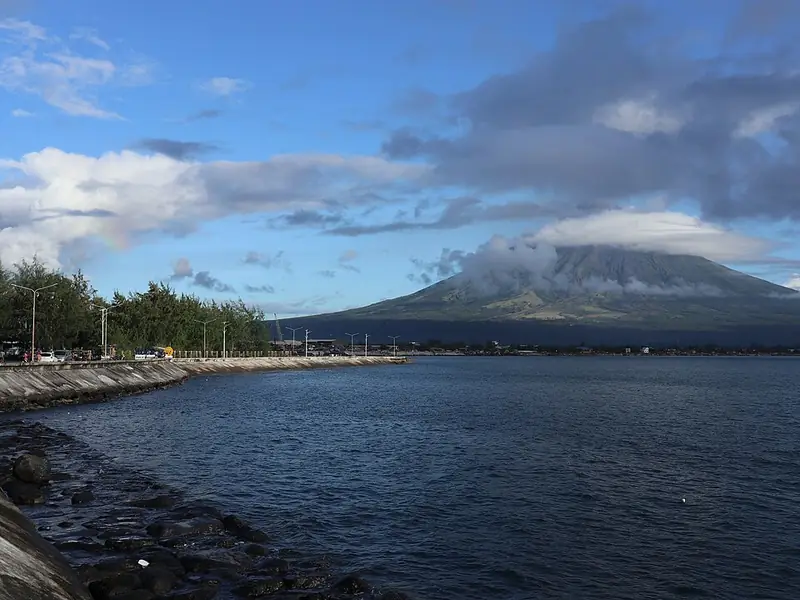
The city's waterfront on Albay Gulf, part of the Legazpi Boulevard that also serves as a seawall against storm surges. Mayon rises behind the city on clear mornings. Food stalls and restaurants serve along the baywalk in the evenings.
Hoyop-Hoyopan Cave
A large limestone cave in Camalig municipality used as a shelter by pre-colonial inhabitants. Artifacts have been found inside. Guided tours navigate the main chambers, which include formations and a small underground stream.
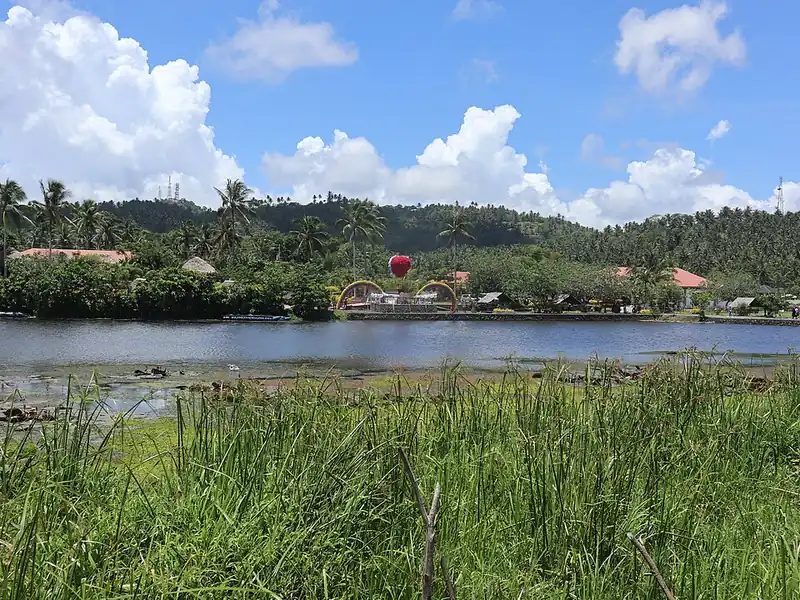
A calm freshwater lake in Camalig with Mayon reflected in its surface on still mornings. Kayaking and bamboo raft rentals are available. The reflection of the volcano on the lake is one of the more striking natural compositions in the province.
◆
Permanent Danger Zone
PHIVOLCS maintains a 6-kilometer permanent danger zone around Mayon's summit. Trekking closer than the designated ATV/jeep routes is prohibited and carries real risk even during quiet periods. Monitor alert levels before travel.
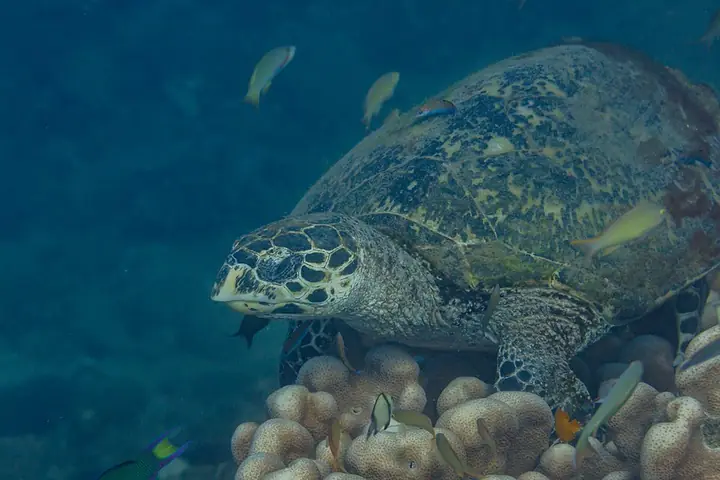
Mayon Volcano Natural Park covers about 5,776 hectares around the volcano. It was first protected as a national park in 1938 and became a natural park in 2000. Beyond it, the Albay Biosphere Reserve, recognized by UNESCO in 2016, covers about 250,000 hectares of land and sea. It holds 182 land plant species, 46 of them found only in the Philippines, and its coasts have mangroves, seagrass and seaweed beds. Its waters are used by five of the world's seven sea turtle species.
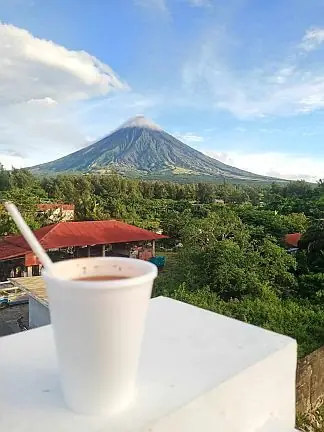
There is no better view for a morning coffee than Mayon Volcano. On a recent pullout in Albay, our team took our coffee with Mayon standing over us, and the scenery more than matched the brew.
Mayon rises about 2,463 meters above the Albay Gulf, the highest point in the Bicol Region and famous worldwide for its near-perfect cone. It is a stratovolcano of the Pacific Ring of Fire, and the most active in the country.
Its eruptions have shaped both the land and the life around it. The ash has made the soil rich, good for the region's pili nuts and its famous spicy peppers. To sit with coffee in Mayon's shadow is to take in centuries of history in one quiet moment.
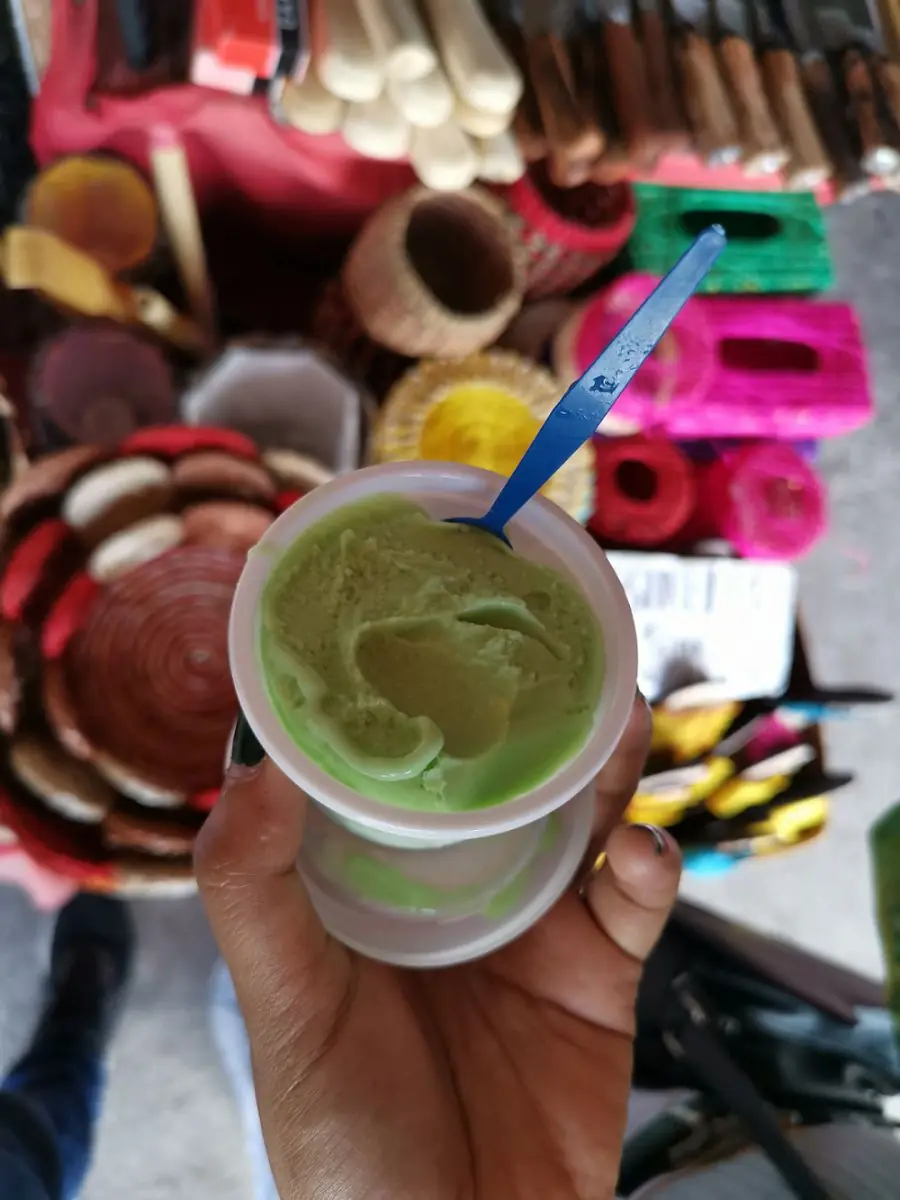
Chili runs through Bicol cooking, so it should be no surprise that it turns up in dessert. In Albay, the treat visitors come looking for is sili ice cream.
It is sweet on the first lick, then a warm, spicy bite follows. The famous maker is the 1st Colonial Grill in Legazpi, which serves it in graduated heat levels, from a gentle level one up to a fiery top tier. Try it, and be oragon, brave.
Legazpi capital and largest city; Ibat, Libog, Gat Ibal, Sawangan; 1569 landing at Ibalon; Camarines and Ibalon; 1636 separation; 1846 Masbate comandancia; UNESCO biosphere reserve March 2016, 250,000 ha, 182 plant species (46 endemic), five of seven marine turtle species; Bikol languages of Albay — Wikipedia: Albay (rev. 1375501350)
Mayon: 2,463 m; most active volcano in the Philippines, over 52 eruptions in 500 years; first eruption 1616; 1 February 1814 Cagsawa, about 1,200 dead (PHIVOLCS); 1984 evacuation of 73,000; 1993 pyroclastic flows killed 79 — Wikipedia: Mayon (rev. 1376798171)
Legazpi: RA 306 (18 July 1948); RA 993 (1954); RA 2234 (12 June 1959); Bicol International Airport in Daraga; Legazpi Boulevard seawall — Wikipedia: Legazpi, Albay (rev. 1378362222)