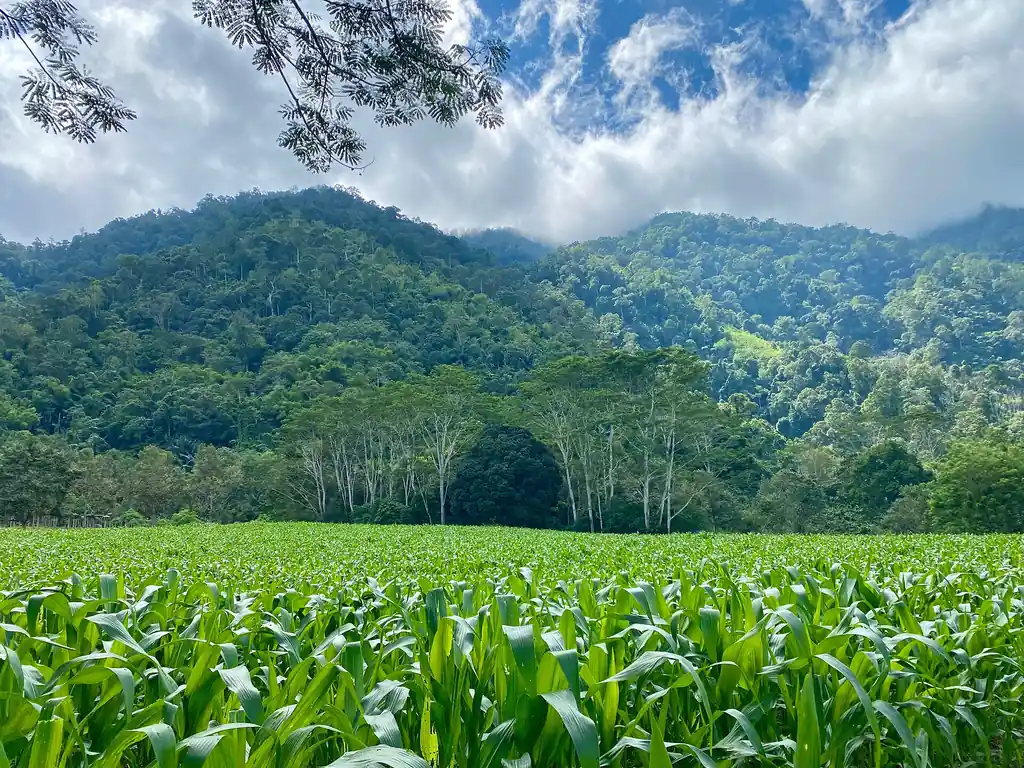
Forested mountains above a cornfield in Maragusan, Davao de Oro
Photo: Greeneggplantz · CC BY-SA 4.0 · Wikimedia Commons
Map

Davao de Oro

Davao Region
Mindanao
Capital Nabunturan
Population (2024) 783,775
Area 4,480 km²
Municipalities 11
Cities 0
Island Group Mindanao
Languages Cebuano, Mansaka, Mandaya

Population: 2024 census (PSA). Area: land area.

Kapitbahay — Neighboring Provinces

Davao de Oro, formerly Compostela Valley, is a landlocked province in the Davao Region of eastern Mindanao. It was renamed in 2019, the new name reflecting its status as one of the richest mineral provinces in the Philippines — gold, chromite, nickel, and copper are found in commercial quantities across its mountainous terrain.

NabunturanCapital
4,480 km²Area
11Municipalities
MindanaoIsland Group
Davao (XI)Region
Compostela ValleyFormer name

Land of Gold

The province's terrain is rugged and heavily forested, drained by the Davao River system. Small-scale gold mining has been practiced in the mountains for generations alongside large-scale commercial extraction.

★
Did You Know?

Super Typhoon Pablo (Bopha), the strongest typhoon on record to hit Mindanao, swept across Compostela Valley in December 2012 after making landfall in Davao Oriental. It killed 1,067 people across the country, many of them in New Bataan.

Davao de Oro had 783,775 people in the 2024 census. Its 11 towns are led in population by Monkayo, while Nabunturan is the capital. Most residents descend from migrants from Cebu, Bohol, Samar and other Visayan provinces, and Cebuano is the main language. The original inhabitants include the Mansaka, Mandaya, Dibabawon, Mangguangan, Kalagan and Manobo groups.
The territory that became Compostela Valley was long inhabited by the Mansaka, Mandaya, Dibabawon, Mangguangan and other indigenous peoples, who practiced swidden agriculture and small-scale gold panning in the mountains. Lowland migration in the 20th century brought Visayan and Mindanao settlers who developed agricultural land and began commercial mineral extraction.

Pre-colonial

Indigenous Settlement

The Mansaka and Mandaya peoples inhabit the mountains and valleys of the area, trading gold with coastal polities and maintaining distinct ceremonial and material cultures.

1960s–1970s

Large-Scale Migration

Government resettlement programs and spontaneous migration bring large numbers of settlers from Visayas and other parts of Mindanao to Compostela Valley. Agricultural frontier land is opened. Indigenous communities are displaced from ancestral domains.

1998

Province Created

Republic Act No. 8470, signed by President Fidel V. Ramos on 30 January 1998, created the province from Davao del Norte under the name Compostela Valley. It was ratified in a plebiscite on 7 March 1998. It was the country's 78th province, with Nabunturan as its capital.

December 2012

Typhoon Pablo (Bopha)

Super Typhoon Bopha made landfall in Baganga, Davao Oriental, on 4 December 2012 and swept across Mindanao. Floods and landslides hit Compostela Valley hardest, along with Davao Oriental, and New Bataan was one of the worst-hit towns. The typhoon killed 1,067 people in all, with 834 more missing.

2019

Renamed Davao de Oro

Republic Act No. 11297 renamed Compostela Valley as Davao de Oro, and the change was ratified in a plebiscite in December 2019. Provincial officials said the new name would end confusion with Cagayan Valley and the town of Compostela in Cebu, and point to its gold.

The dominant cultural groups of Davao de Oro are the Mansaka and the Mandaya — two distinct but related Austronesian-speaking peoples of eastern Mindanao. Both groups have elaborate weaving traditions, brasswork, and ceremonial music, and both have experienced significant disruption from the 20th-century in-migration that transformed their ancestral territories.

Mansaka and Mandaya Traditions

The Mansaka are known for their brass work — traditional jewelry, ceremonial objects, and tools cast in brass using lost-wax techniques — and for their inaul weave, a traditional textile with geometric patterns. The Mandaya produce the dagmay cloth, woven with intricate patterns using abaca fiber. Both traditions have been disrupted by 20th-century settlement but are maintained by practitioners in highland communities.

★
Pananggalang Shield

The pananggalang — a traditional Mandaya and Mansaka war shield made from hardwood and decorated with geometric patterns — is among the most recognized examples of Mindanao indigenous material culture in museum collections.

The province's lowland communities are predominantly Cebuano-speaking migrants and their descendants, whose cultural life combines Cebuano Visayan traditions with adaptations to Mindanao's frontier conditions. Mining camp culture, with its distinct social dynamics, also shapes communities near extraction operations.

See the great festivals in Pista ng Pilipinas →

Davao de Oro's food culture is essentially Cebuano-Mindanao in its lowland communities and indigenous in its highland areas. The province's rivers provide freshwater fish; its forests and farms supply root crops, vegetables, and game. The food is utilitarian — a frontier province's diet built on availability and sustenance.

Mansaka Tupig

Glutinous rice mixed with coconut milk and young coconut strips, wrapped in banana leaves and grilled over charcoal. The banana leaf imparts a smoky, slightly charred flavor to the sticky rice inside. Eaten as a snack or breakfast food in Mansaka communities.

Sinuglaw

A combination dish of sinugba (grilled pork) and kinilaw (raw fish in vinegar) popular across Mindanao. In Davao de Oro, river fish or freshwater shrimp often replaces the saltwater fish. Served with raw onion, ginger, and chili.

Freshwater Shrimp Sinigang

Mindanao / Davao Region
15 minutesPrep
25 minutesCook
4Serves
Ingredients
  • 500g, wholeFreshwater shrimp (hipon sa ilog)
  • 200g fresh, or 3 tbsp sinigang mixTamarind
  • 3, quarteredTomatoes
  • 1, quarteredOnion
  • 1 bundleWater kangkong (swamp cabbage)
  • 1, slicedRadish (labanos)
  • 2Long green chili
  • 6 cupsWater
  • 2 tablespoonsPatis (fish sauce)
  • to tasteSalt
Method
  1. Boil tamarind in 2 cups water until soft. Strain and reserve the sour liquid. Discard pulp.
  2. In a large pot, bring 4 cups water to a boil. Add onion and tomatoes. Simmer 5 minutes.
  3. Add tamarind liquid and patis. Taste for sourness — add more tamarind liquid as needed.
  4. Add radish. Cook 5 minutes.
  5. Add shrimp and long green chili. Cook 4–5 minutes until shrimp turn pink and curl.
  6. Add kangkong in the final 2 minutes. Season with salt.
  7. Serve immediately — the vegetables should be just cooked, not wilted.
Cook's note

Freshwater shrimp are sweeter and more delicate than saltwater varieties. Do not overcook — they become tough quickly. The sourness level should be assertive but not mouth-puckering.

Cebuano is the dominant language in most of Davao de Oro's lowland municipalities, brought by the 20th-century migrant settlers. In highland and interior areas, Mansaka and Mandaya are spoken — Mansaka is the more widely distributed indigenous language in the province. Both Mansaka and Mandaya are Austronesian languages of the Mansakan group, related to Kalagan.

CebuanoLowland lingua franca
MansakaPrimary IP language
MandayaOther IP language
Filipino, EnglishOfficial

Mansaka has an oral literary tradition of chanted stories and songs performed at ceremonies, which carry the community's history, genealogy and customary law. Documentation of this tradition has been undertaken by academic researchers and cultural NGOs, but transmission to younger generations is uncertain as Cebuano spreads.

Besides Mansaka and Mandaya, smaller communities speak Kalagan, Dibabawon and Ata Manobo. Tagalog and English are used in school, government and business, as elsewhere in the Davao Region.

Davao de Oro is accessible from Davao City, the regional center, about 80–120 kilometers to the south depending on the destination. The province has no commercial airport; travelers arrive overland via the national highway network. Check current travel advisories before visiting remote areas.

2–3 hours by bus/carFrom Davao City
Francisco Bangoy Int'l, Davao CityNearest airport
Security advisories for interior areasCheck before visit
March–May (drier)Best months

Mansaka Cultural Villages

Several municipalities in the highland areas of Davao de Oro maintain Mansaka community centers where traditional crafts — brass casting, inaul weaving — are practiced and demonstrated. Visits are most meaningful when arranged through local government or indigenous peoples organizations to ensure proper protocols and benefit to the community.

Nabunturan Town Center

The provincial capital is a working administrative town with the provincial government buildings, a small commercial district, and a market. The Davao de Oro Provincial Museum has artifacts and historical materials related to the province's indigenous cultures and colonial history.

◆
Travel Advisory

Check current advisories from the Department of Tourism and local government before visiting, particularly for remote municipalities.

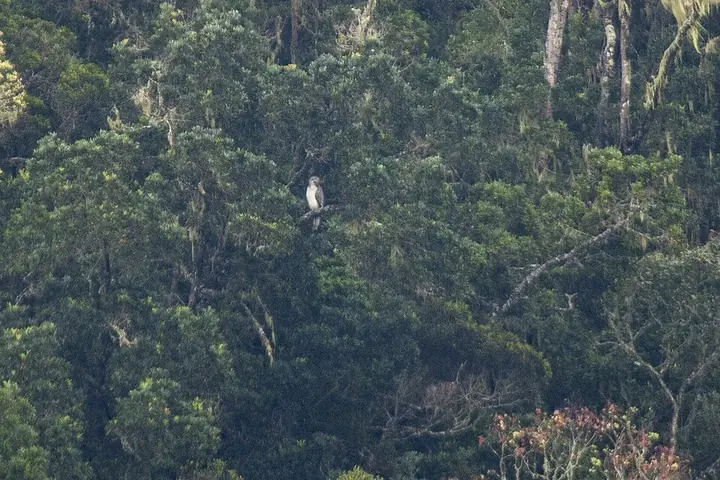
The forests of Mount Candalaga in Maragusan are among the last old-growth forests of Davao de Oro. A Philippine eagle was first confirmed there in October 2022, and in 2025 the Philippine Eagle Foundation documented the first active Philippine eagle nest in the province. The area is being considered for declaration as a critical habitat.

A Philippine eagle in the wild (photographed in Mindanao)
Photo: Francesco Veronesi from Italy · CC BY-SA 2.0 · Wikimedia Commons
Philippine Eagle
Pithecophaga jefferyi
Critically Endangered
The national bird, found only in the Philippines. A young eagle from the Mount Candalaga nest was fitted with a GPS tracker in February 2026 so researchers can follow its movements.
Field note: Report sightings to the PENRO in Nabunturan, and never disturb a nest.
Rafflesia magnifica
Rafflesia magnifica
Critically Endangered
A giant parasitic flower with no leaves or stem, found only in Mindanao, around Mount Candalaga in Davao de Oro. The mountain shelters both this flower and the Philippine eagle.
Field note: Do not touch or step near the buds. They take months to open and are easily killed.
Meet all 65 Philippine animals in Hayop ng Pilipinas →

New Bataan, December 2012

Typhoon Bopha was not supposed to hit Mindanao. The standard track for Pacific typhoons bends northward; Mindanao sits below the typical track. The communities of Compostela Valley had no typhoon culture — no ingrained protocols for what to do when a Category 5 storm approaches — because in living memory no storm of that magnitude had come directly at them.

New Bataan, a municipality of around 50,000 people in the valley, received the worst of it. Flash floods and landslides came down the mountain slopes in the dark hours of December 4. The Davao River system, which drains the valley, became the instrument of destruction. Compostela Valley was the worst-hit province; nationwide the typhoon killed 1,067 people. Many of the dead were in evacuation centers in low-lying areas that the flood reached anyway.

The name change to Davao de Oro in 2019 was partly administrative and partly an attempt to reframe how the province was known. The gold is real — the mining has been going on for a century — and the name is accurate. But the people of New Bataan who rebuilt their town after Bopha did not do it because the province was renamed. They did it because they had nowhere else to go, and because the valley, when the river was calm and the soil was dry, was still good land.

Sources · updated 4 October 2026
Photo credits (2)

Photos from Wikimedia Commons, used under the licences shown; some were resized. All photo credits