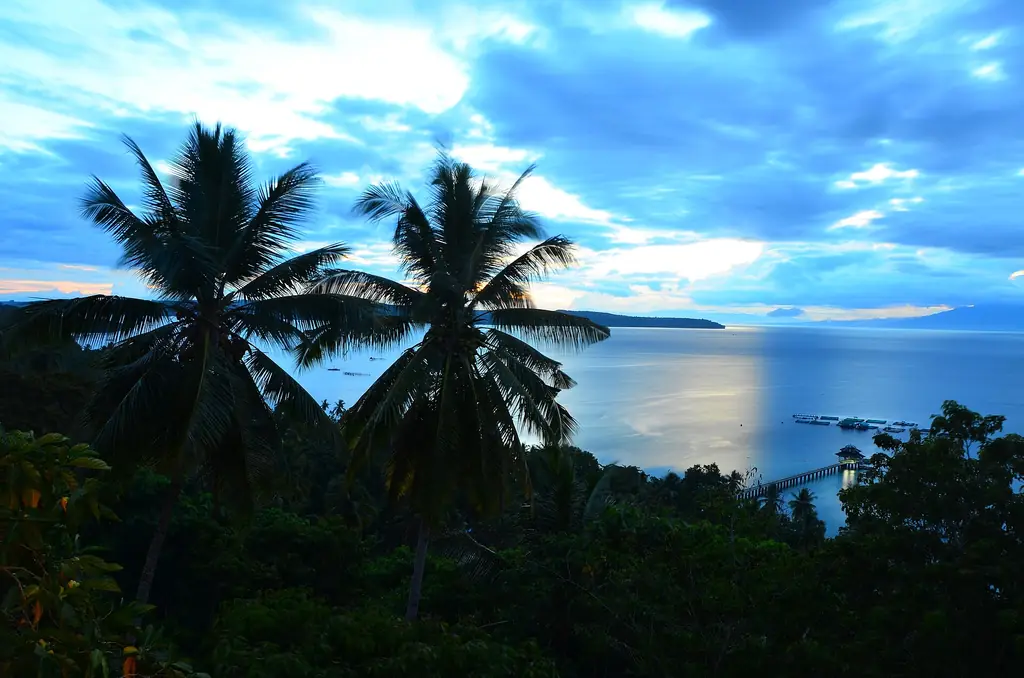
Palms on Samal Island looking toward Talikud Island at dusk
Photo: Lachlan Fearnley · CC BY-SA 3.0 · Wikimedia Commons
Map

Davao del Norte

Davao Region
Mindanao
Capital Tagum City
Population (2024) 1,143,931
Area 3,427 km²
Municipalities 8
Cities 3
Island Group Mindanao
Languages Cebuano, Mansaka, Mandaya

Population: 2024 census (PSA). Area: land area.

Kapitbahay — Neighboring Provinces

Davao del Norte is a province in the Davao Region of southeastern Mindanao, north of Davao City. Its capital, Tagum City, is the province's largest city, with 296,202 people in 2020 — a mid-sized urban center built on agricultural commerce and expanding services. The province is an agricultural powerhouse: banana and pineapple plantations dominate the lowlands, with Cavendish banana export a major industry tied to global supply chains.

Tagum CityCapital
3,427 km²Area
8Municipalities
3 (Tagum, Island Garden of Samal, Panabo)Cities
MindanaoIsland Group
Davao (XI)Region

Agriculture and Urban Growth

The province's agricultural economy centers on Cavendish bananas — the province calls itself the Banana Capital of the Philippines, and large plantations in its lowlands grow fruit for export. Pineapple and rubber are also significant crops. The agricultural wealth generated by these plantations has funded Tagum City's growth as a commercial and services hub for the northern Davao Region.

★
Did You Know?

The Island Garden City of Samal (IGACOS) in Davao del Norte covers two whole islands in the Davao Gulf, Samal and Talikud, about 2 kilometers across the channel from Davao City. Barges and passenger boats run from the Sasa and Santa Ana wharves, and the island's beaches, reefs and resorts draw visitors year-round.

Davao del Norte was created in 1967 when the original Davao Province — a massive administrative unit — was divided into three separate provinces. Its coast and the island city of Samal face the Davao Gulf.

The 2024 census counted 1,143,931 people in Davao del Norte, the most populous province of the Davao Region, across eight municipalities and three component cities: Tagum, Panabo and Samal. It borders Agusan del Sur to the north, Bukidnon to the west, Davao de Oro to the east and Davao City to the south. Its highest point is Mount Masimalon at 1,115 meters. The western uplands belong to the Pantaron Range, one of the last large blocks of old-growth forest in Mindanao, and the island city of Samal lies out in the Davao Gulf.
The area that became Davao del Norte was part of the vast Davao frontier opened to agricultural settlement in the late 19th and early 20th centuries. In the early 1900s settlers from the Visayas, Luzon, China and Japan arrived, and plantation agriculture boomed.

Early 1900s

Migrants and Plantations

Under American rule, waves of settlers from the Visayas, Luzon, China and Japan arrived in the Davao region, and plantation agriculture boomed around the gulf.

8 May 1967

Province Created

Republic Act No. 4867 divided the old province of Davao into Davao del Norte, Davao del Sur and Davao Oriental. Davao del Norte began with thirteen municipalities, and six more were created in 1970.

1972

Renamed Davao; the Banana King

Republic Act No. 6430 of 17 June 1972 renamed the province Davao. Under martial law, Marcos ally Antonio Floirendo Sr. was allowed to lease 6,000 hectares of government land, far above the 1,024-hectare limit, and to use prisoners from the Davao Penal Colony as laborers, building the export plantations that made him the "Banana King."

January 1998

Davao de Oro Split Off

Republic Act No. 8470 created Compostela Valley (now Davao de Oro) from the province's eastern towns, and the name Davao del Norte was restored. Tagum became a city, and Samal, Babak and Kaputian merged into the Island Garden City of Samal.

5 March 2001

Panabo Becomes a City

Republic Act No. 9015 converted Panabo into a city, the province's third.

2026

San Isidro Renamed Sawata

The municipality of San Isidro, created from parts of Asuncion and Kapalong in 2004, was renamed Sawata after a plebiscite.

Davao del Norte is culturally diverse, reflecting the layers of settlement that characterize the Davao Region: Lumad indigenous peoples in the highlands and some coastal areas, Visayan migrants and their descendants in the lowlands and cities, and Moro Muslim communities in some coastal barangays. Cebuano is the dominant language of everyday communication.

Lumad Heritage

The province's indigenous peoples include the Mansaka, whose language is one of the province's main tongues; Mandaya, a related Mansakan language, is also spoken here. Ata Manobo and Kalagan are native languages of Samal Island, and the Manobo and other Lumad peoples live in the Pantaron Range, where the government has identified ancestral domain claims. Samal's Hugyaw Madayaw festival in August was started partly to keep the island's Sama culture alive.

★
Tagum Musikahan

The Musikahan sa Tagum festival is an annual music competition and showcase held in Tagum City, celebrating the province's cultural diversity. It has become one of the more significant cultural events in the Davao Region.

The Kadayawan Festival of Davao City, held each year in August, is the Davao Region's best-known celebration of the harvest and of its indigenous peoples. Samal's Hugyaw Madayaw festival is a spin-off of it, held in the same month.

See the great festivals in Pista ng Pilipinas →

The food of Davao del Norte follows the Cebuano-Mindanao tradition, with the abundance of a major agricultural province available in markets and kitchens. Bananas appear in multiple forms beyond the raw fruit — banana blossom (puso ng saging) is cooked as a vegetable; saba bananas are fried, boiled, or made into desserts. Pork, fresh seafood from Davao Gulf, and abundant tropical produce are the foundations.

Tinolang Isda sa Gata

Fish cooked in coconut milk with ginger, green papaya, and malunggay (moringa) leaves. The Davao del Norte version uses fresh-caught fish from the gulf or freshwater varieties from rivers. The coconut milk is light rather than thick, making this a brothy dish closer to a soup.

Puso ng Saging Kare-Kare

A vegetarian variation of the classic Filipino kare-kare, using banana blossom in place of meat. The banana blossom is braised in peanut sauce with eggplant and banana heart, served with bagoong alamang on the side. In a province of banana plantations, the blossom is free — it is cut from the bunch before harvest.

Inun-unan na Isda (Sour-Braised Fish)

Cebuano-Mindanao tradition
15 minutesPrep
25 minutesCook
4Serves
Ingredients
  • 600gFish (tilapia, bangus, or any firm fish), whole or steaks
  • ½ cupCoconut vinegar
  • 1 cupWater
  • 2 thumbs, slicedGinger
  • 1, slicedOnion
  • 4 cloves, crushedGarlic
  • 3Long green chili
  • to tasteSalt
  • ½ teaspoonBlack pepper
Method
  1. Combine vinegar, water, ginger, onion, garlic, salt, and pepper in a wide pan. Bring to a simmer.
  2. Add fish. Do not stir — let the liquid come back to a simmer.
  3. Cover and cook over medium heat 15–20 minutes, turning fish once halfway through.
  4. Add chilies in the last 5 minutes.
  5. The liquid should reduce to a concentrated sour-savory sauce by the end. If still too liquid, simmer uncovered a few minutes more.
  6. Serve with rice.
Cook's note

Inun-unan is essentially escabeche without frying — a vinegar braise that both cooks and lightly preserves the fish. It keeps refrigerated for two days, the flavor intensifying as it rests.

✦
Tropical Fruit

Davao del Norte's markets carry exceptional tropical fruit — pomelo, mangosteen, rambutan, durian, and varieties of banana unavailable elsewhere. The Tagum City market is the place to explore the full range. Durian season is June to September.

Cebuano is the dominant language of Davao del Norte, spoken by the majority of the lowland and urban population descended from Visayan settlers. Mansaka, Mandaya and other Lumad languages are spoken by indigenous communities, and Ata Manobo and Kalagan on Samal Island. Tagalog and English are used in government, education, and formal settings.

CebuanoPrimary language
Mansaka, Mandaya, Ata Manobo, KalaganIndigenous
Tagalog, Filipino, EnglishOther
Tagum City (multilingual)Urban center

The linguistic diversity of the province reflects its settlement history. In Tagum's markets, Cebuano mixes with Tagalog and with the languages of settlers from across the Visayas and Luzon. This mix is characteristic of Mindanao frontier cities built by migration from multiple origin points.

The region also has its own Davaoeño (Dabawenyo) language, a Mansakan language influenced by Cebuano and Tagalog. It was once the main language of the Davaoeño people, but in Davao City speakers have shifted to a local form of Cebuano that is also often called Davaoeño.

Davao del Norte is reached from Davao City — the regional hub with an international airport — about 50–80 kilometers to the south. Tagum City is a 1–1.5 hour drive from Davao City on the national highway. The province is also a stopping point on the route north through Mindanao toward Bukidnon and the Cagayan de Oro–Manila highway.

1–1.5 hours to TagumFrom Davao City
Francisco Bangoy Int'l, Davao CityNearest airport
Boat or barge from Sasa or Santa Ana wharfIsland Garden City of Samal
March–June (drier season)Best months

Island Garden City of Samal (IGACOS)

Samal, a component city of Davao del Norte, covers Samal Island and the smaller Talikud Island in Davao Gulf. Boats and barges cross from the Sasa and Santa Ana wharves in Davao City. The island has white-sand beaches, reefs (especially around Talikud) and dozens of resorts; hills rise in the interior.

Tagum City Rizal Park and Libi Lake

The center of Tagum City is organized around a public park system that includes Libi Lake — a small lake within city limits that has been developed as a recreation area with walking paths and food stalls. The city's rapid development is evident in its modern commercial buildings alongside older low-rise commercial strips.

Banana Plantation Country

The lowlands of Davao del Norte — particularly around Panabo City and the municipalities — are covered in Cavendish banana plantations. Driving through this landscape conveys the scale of Philippine export agriculture. Panabo City has developed a small agri-tourism circuit including plantation visits through local government.

Monfort Bat Sanctuary

A cave on Samal Island, about a kilometer from Davao City, that holds what Guinness World Records lists as the largest colony of Geoffroy's rousette fruit bats; Bat Conservation International estimated 1.8 million in 2006. The Monfort family has protected the cave on their land since the 1900s. Late afternoon visits catch the evening flight, when the bats stream out after sunset.

Davao del Norte runs from the Davao Gulf coast up into the Pantaron Range, the Central Cordillera of Mindanao, whose old-growth forest is home to the Philippine eagle, the Philippine brown deer, the Philippine flying lemur and a Mindanao-endemic gymnure, and which is threatened by mining and logging. Out in the gulf, at least ten species of toothed whales and dolphins have been recorded, and whale sharks and sea cows are seen often. On Samal Island, the Monfort cave shelters a colony of fruit bats estimated at 1.8 million.

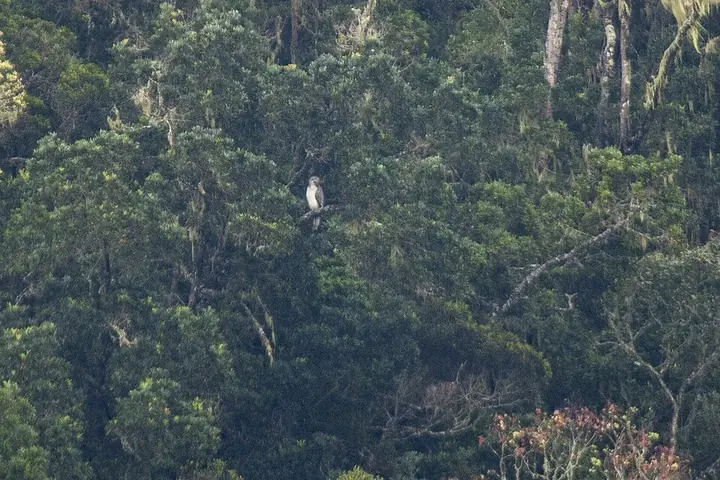
A Philippine eagle in the wild (photographed in Mindanao)
Photo: Francesco Veronesi from Italy · CC BY-SA 2.0 · Wikimedia Commons
Philippine Eagle
Pithecophaga jefferyi
Critically Endangered
The national bird and, by length and wing area, the largest living eagle. It survives in the old-growth forest of the Pantaron Range, and each breeding pair needs a very large home range, which makes it highly vulnerable to logging.
Field note: Report sightings or nests to the Philippine Eagle Foundation and keep well away; never disturb a nest.
Geoffroy's Rousette
Rousettus amplexicaudatus
Least Concern
A medium-sized fruit bat that roosts in dark caves and feeds on fruit, nectar and pollen. The Monfort cave on Samal holds the largest known colony of the species.
Field note: Watch the evening flight from outside the cave; do not enter or use lights near roosting bats.
Meet all 65 Philippine animals in Hayop ng Pilipinas →

The Bats of Monfort Cave

On a hillside in Samal, the Iñigo-Monfort family has kept watch over a cave since the 1900s. Inside, fruit bats cover about three-quarters of the ceilings and walls of a 75-meter cave. Bat Conservation International estimated the colony at about 1.8 million in 2006, and Guinness World Records lists it as the largest colony of Geoffroy's rousette anywhere.

Norma Monfort, who owns the 57 acres around the cave, fenced the property against hunters and hired round-the-clock guards. In 2011 she was named a Disney Worldwide Conservation Fund Hero. Visitors watch from outside, because any disturbance can panic the bats, and the best time to come is just before sunset, when the colony pours out of the cave entrances to feed.

The bats feed on fruit, nectar and pollen, and the cave is one of the island city's best-known sights, only a short boat ride across the channel from Davao City.

Sources · updated 4 October 2026
Photo credits (2)

Photos from Wikimedia Commons, used under the licences shown; some were resized. All photo credits