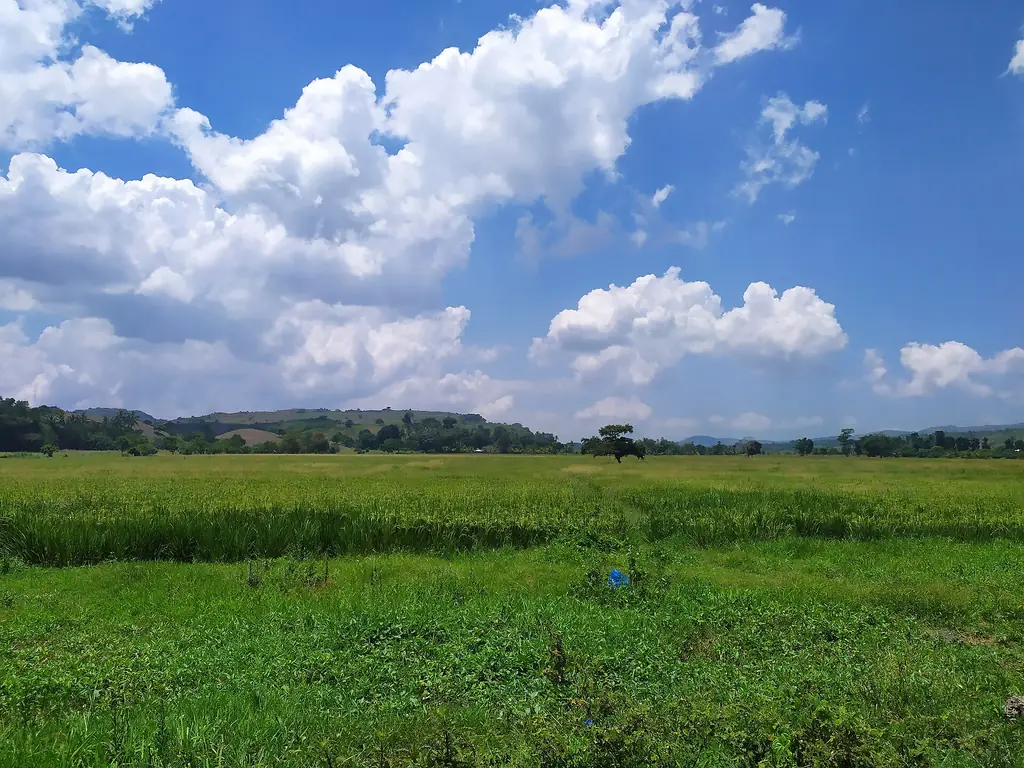
Green fields and hills at Nangi, Upi
Photo: LuzViMindaLife · CC BY-SA 4.0 · Wikimedia Commons
Map

Maguindanao del Norte

BARMM
Mindanao
Capital Datu Odin Sinsuat
Population (2024) 1,124,811
Area 4,752 km²
Municipalities 12
Cities 1
Island Group Mindanao
Languages Maguindanaon, Iranun, Teduray

Population: 2024 census (PSA). Area: land area. Population, area and city count include Cotabato City, which the census lists separately from the province.

Kapitbahay — Neighboring Provinces

Maguindanao del Norte is one of two provinces created in 2022 when the old Maguindanao province was divided. It occupies the northern and coastal portion of the former province. Its capital is Datu Odin Sinsuat by law, but in practice the provincial government sits in Sultan Kudarat. The province is part of the Bangsamoro Autonomous Region in Muslim Mindanao (BARMM) and is the only one of the two Maguindanao provinces with a coastline, facing Illana Bay on the Moro Gulf.

Datu Odin SinsuatCapital
4,752 km²Area
12 + 1 cityMunicipalities
MindanaoIsland Group
BARMMRegion

The province borders Lanao del Sur to the north, Cotabato to the east, Maguindanao del Sur to the southeast, and Sultan Kudarat to the south, with Illana Bay to the west. Bongo Island, offshore, falls under its jurisdiction. The Mindanao River reaches the sea at Cotabato City, an independent component city that is administratively separate from the province but grouped with it. The population (1,124,811 in the 2024 census) and area (4,752 km²) shown for Maguindanao del Norte include Cotabato City.

★
Polloc Harbor

Polloc, now a barangay of Parang, has a natural deep-water harbor. Spanish forces from Zamboanga seized it in 1851 and built a fort and naval base there, and the settlement around it grew into a small town.

The population is predominantly Maguindanaon and Muslim, with Iranun communities along the coast and Teduray communities in the Upi uplands. Rice farming along the lower Mindanao River and fishing along Illana Bay are major livelihoods.

The 2024 census, taken before the province formally began, counted 1,124,811 people in the area of Maguindanao del Norte; about a third of them live in Cotabato City. Maguindanaon are the largest group. Iranun are the majority in the three northernmost towns, Matanog, Buldon and Barira; Teduray in Upi; and Maranao live along the northern and western borders.
The territory of Maguindanao del Norte was historically part of the Sultanate of Maguindanao, a major Islamic state of the southern Philippines in the 17th and 18th centuries. The sultanate controlled the Mindanao River basin and collected tribute from communities throughout the region. Spanish forces raided and fought it many times but never fully conquered the Maguindanao heartland. Its rulers sat near the mouth of the Mindanao River and along this coast: Sultan Kudarat ruled from Lamitan and later from Simuay, in present-day Sultan Mastura.

c. 1515

Sharif Kabungsuwan

According to tradition, Sharif Muhammad Kabungsuwan, a missionary from Johor, arrived in the Mindanao River basin around 1515 and founded the Sultanate of Maguindanao, which he led until 1543.

1637

Corcuera's Expedition

On 13 March 1637, Governor-General Sebastián Hurtado de Corcuera landed at Lamitan, Sultan Kudarat's capital, and took it. Kudarat escaped and moved his court to Simuay, where he ruled until 1671, and the sultanate was never fully conquered by Spain.

1973

Maguindanao Province

In 1973 the old province of Cotabato was split into Maguindanao, Cotabato and Sultan Kudarat.

2006–2008

Shariff Kabunsuan

In October 2006 the first district of Maguindanao, roughly today's province, became the province of Shariff Kabunsuan under a law of the ARMM assembly. In July 2008 the Supreme Court voided its creation, ruling that only Congress can create provinces, and the towns returned to Maguindanao.

2022–2023

A New Province

Voters approved Republic Act No. 11550 in a plebiscite on 17 September 2022, dividing Maguindanao into Maguindanao del Norte and Maguindanao del Sur. The new province formally began on 9 January 2023, after a transition period. Datu Odin Sinsuat is its legal capital, while the provincial government sits in Sultan Kudarat.

Maguindanaon culture is organized around Islam and the sultanate system. The political influence of datus (nobles) and the sultan remains active, operating alongside the formal BARMM government. Social hierarchies based on lineage, religious learning, and political alliance shape community life in ways that formal administrative boundaries do not easily contain.

Kulintang Music

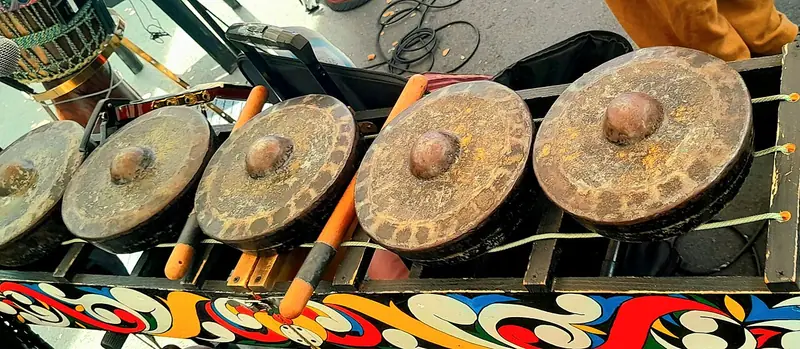
A set of kulintang gongs
Photo: Buszmail · CC BY-SA 4.0 · Wikimedia Commons

The kulintang — a row of small bronze gongs played with padded mallets — is the central instrument of Maguindanaon music. The kulintang ensemble typically includes the large agung gong, the gandingan (four large hanging gongs), the dabakan drum, and the babendil (single gong). Kulintang music is performed at weddings, ceremonies, and social gatherings. Kulintang-type gongs are played across Mindanao, Sulu and eastern Indonesia, and in the Philippines the music is regarded as the highest form of its gong tradition.

★
Kulintang and Southeast Asian Music

The kulintang gong tradition is related to similar gong ensemble traditions found throughout island Southeast Asia — in Indonesia (gamelan), Malaysia, and Brunei. The Philippine kulintang may predate the arrival of Islam in Mindanao by several centuries.

Traditional clothing remains in active use in Maguindanao del Norte. The malong — a tubular cloth worn in multiple configurations by both men and women — is everyday wear for many residents. Fine malong are woven with geometric patterns specific to particular communities and serve as markers of identity and status.

Sultan Kudarat

KD

Sultan Muhammad Dipatuan Kudarat

Sultan of Maguindanaoc. 1580–1671

Known in Philippine history as Sultan Kudarat, he ruled the Sultanate of Maguindanao from 1619 to 1671 and was the first to unite its downstream (sa ilud) and upstream (sa raya) domains. He resisted Spanish expansion, traded with the Dutch, and ruled first from Lamitan and later from Simuay, in present-day Sultan Mastura. The province of Sultan Kudarat and this province's town of Sultan Kudarat bear his name.

★
Simuay, Free Port

In 1637 Sultan Kudarat moved his capital from Lamitan to Simuay, today the town of Sultan Mastura, and opened it as a free trading port.

See the great festivals in Pista ng Pilipinas →

Maguindanaon cuisine centers on rice, freshwater fish from the Mindanao River and seafood from Illana Bay, and the spice traditions associated with the Maguindanao sultanate's centuries of trade contact with Malay and Indonesian cultures. Most people are Muslim, so everyday food is halal and pork is rarely served.

Tiula Itum (Black Soup)

A distinctive Maguindanaon dish made by charring or burning coconut meat until blackened, then using it to darken and flavor a broth of beef or chicken. The result is a deep, smoky black soup with rich savory flavor. Tiula itum is served at celebrations and is one of the signature dishes of Maguindanaon banquet culture.

Pyanggang na Manok

Chicken grilled then simmered in a sauce made from charred coconut, spices, and coconut cream. Related to tiula itum in technique, this dish has the characteristic smoky-black appearance of Maguindanaon cooking. The charred coconut base gives the dish its distinctive color and depth.

Satti (Satay Maguindanao)

Maguindanao / Central Mindanao
30 minutes + 1 hour marinatingPrep
20 minutesCook
4Serves
Ingredients
  • 500g, cut into small cubesBeef or chicken
  • 1/2 cupCoconut milk
  • 1 tspTurmeric powder
  • 1 tspChili powder
  • 4 cloves, mincedGarlic
  • 1 tbsp, mincedGinger
  • 1 tspSalt
  • as needed, soaked in waterBamboo skewers
Method
  1. Combine coconut milk, turmeric, chili powder, garlic, ginger, and salt in a bowl.
  2. Add meat and marinate for at least 1 hour, or overnight in refrigerator.
  3. Thread meat onto soaked bamboo skewers.
  4. Grill over charcoal, turning frequently, until cooked through and slightly charred, about 12–15 minutes.
  5. Serve with plain rice and a dipping sauce of vinegar with chili.
Cook's note

Satti in Mindanao is not exactly the Southeast Asian satay but evolved from the same tradition of skewered grilled meat. The turmeric-coconut marinade gives the meat a golden-yellow color and fragrant flavor.

Maguindanaon is the primary language of Maguindanao del Norte. It is an Austronesian language in the same family as Maranao and Iranun, and the three languages share significant mutual intelligibility. Maguindanaon is the native language of the Maguindanaon people, who have lived along the Mindanao River basin for centuries.

MaguindanaonMain language
IranunNorth
TedurayUpi
Maranao, Filipino, EnglishAlso

Arabic is used in religious education and the mosque. Many Maguindanaon words relating to religion, governance, and formal life are borrowed from Arabic, a result of centuries of Islamic practice. Older generations with madrassa education read Jawi (Arabic-script Malay) as well.

★
Cotabato City as a Linguistic Hub

Cotabato City — surrounded by Maguindanao del Norte but administered separately — is a major commercial center where Maguindanaon, Cebuano, Ilocano, Tagalog, and English mix in the markets and streets. It functions as the main urban meeting point for the diverse peoples of central Mindanao.

Iranun is spoken in Barira, Buldon, Parang, Matanog, Sultan Mastura and Sultan Kudarat. Like Maguindanaon and Maranao it is a Danao language, and the Iranun were traditionally renowned sailors and shipbuilders along the coasts of Illana Bay.

Teduray is spoken in Upi, whose name comes from ufi, the Teduray word for the betel-pepper plant. The Teduray are the town's native inhabitants.

Filipino and English are taught in public schools under the BARMM educational system, which also incorporates Maguindanaon-language instruction in early grades. The province has been a focus of mother-tongue based multilingual education reform efforts.

Cotabato Airport, also called Awang Airport, lies within the province in Datu Odin Sinsuat and is the main gateway, with flights from Manila. Roads link Cotabato City with the coastal towns and with Upi.

Cotabato (Awang) Airport, Datu Odin SinsuatEntry Airport
~1 hr 45 minFlight from Manila
Check current advisoriesTravel Note
Illana Bay coast, Polloc, UpiMain Draw

Illana Bay Coast

The province's western shore faces Illana Bay, an arm of the Moro Gulf and the Celebes Sea. Iranun communities have long lived along this coast and around Polloc harbor in Parang, and Bongo Island lies offshore.

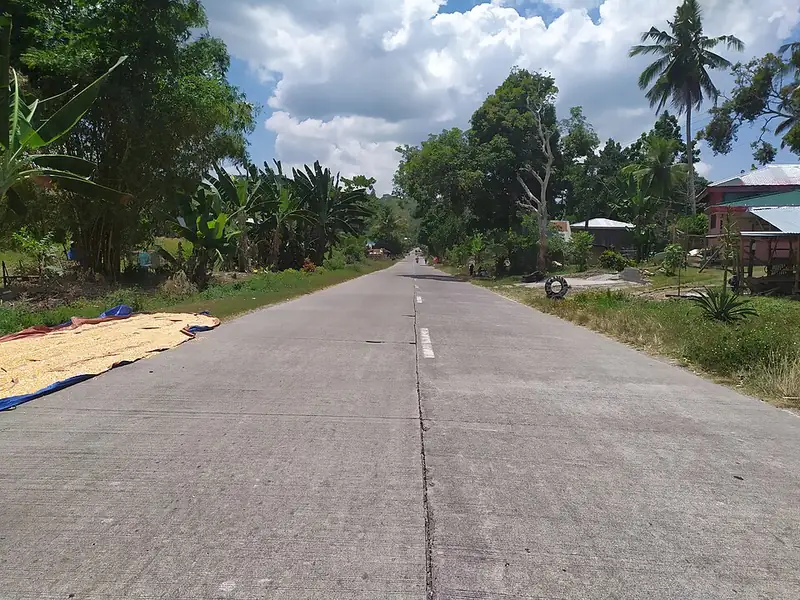
A country road through Nangi, Upi
Photo: LuzViMindaLife · CC BY-SA 4.0 · Wikimedia Commons

Upi

The town of Upi, also called North Upi, lies in the fertile Upi valley in the uplands and is home to the Teduray, its native inhabitants. The Upi Agricultural School was founded here in 1919 by the American officer Irving Edwards.

Cotabato City from the air, October 2023
Photo: Francis 188 · CC0 · Wikimedia Commons

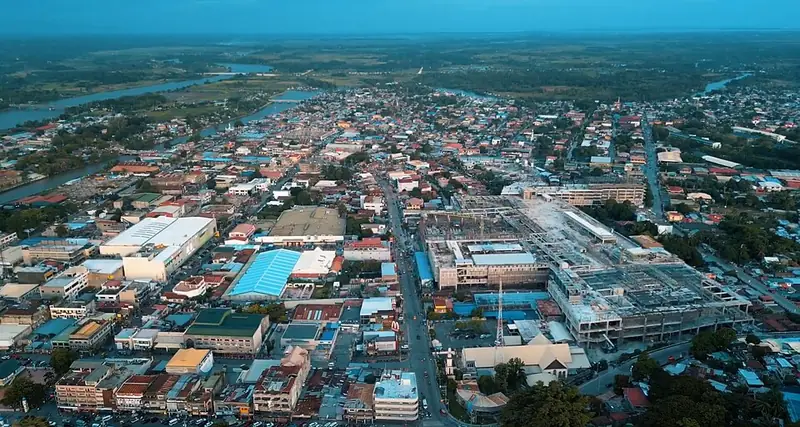
Cotabato City (gateway)

Though not in the province, Cotabato City is the practical base for exploring Maguindanao del Norte. The city has the Grand Mosque of Cotabato (Sultan Haji Hassanal Bolkiah Masjid), the second-largest mosque in the Philippines with room for about 15,000 worshippers, markets selling Maguindanaon brasswork and woven goods, and accommodation options.

◆
Travel Advisory

Travel advisories for Maguindanao del Norte vary by municipality. Always check current official advisories and travel with local guidance.

Maguindanao del Norte runs from the shores of Illana Bay, an arm of the Moro Gulf, to the forested uplands of Buldon, Barira and Matanog, whose dense watershed forests are threatened by illegal logging of dipterocarp trees such as lawaan. In the lowlands, the remaining freshwater swamp forest of Ebpanan Marsh still shelters threatened birds: a 2022 rapid survey recorded 36 species there, eight of them found only in the Philippines.

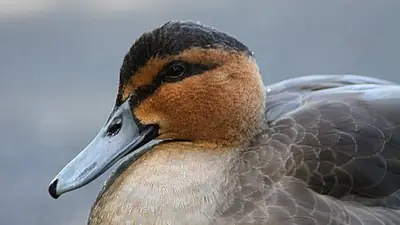
Head of a Philippine duck
Photo: Ken Billington · CC BY-SA 3.0 · Wikimedia Commons
Philippine Duck
Anas luzonica
Least Concern
A dabbling duck found only in the Philippines, with a rusty-cinnamon head and a dark crown. It was recorded at Ebpanan Marsh in 2022. It is listed as Least Concern, but hunting and the draining of wetlands remain the main threats.
Field note: Keep marshes undrained and do not hunt wild ducks.
Java Sparrow
Padda oryzivora
Endangered
A gray finch with a heavy pink bill and white cheeks, recorded at Ebpanan Marsh in the 2022 survey. It is popular as a cage bird, and trapping for the pet trade has made it rare in the wild.
Field note: Never buy wild-caught songbirds.
Meet all 65 Philippine animals in Hayop ng Pilipinas →

The Sultan Who Traded with Everyone

Sultan Kudarat understood something about power that the Spanish never fully grasped: that the Mindanao River was a road, and whoever controlled the road controlled the interior. The sultan's court moved between multiple locations along the river, maintaining authority not through a fixed capital but through constant presence, kinship networks, and the ability to mobilize warriors faster than any outside power could send ships.

When the Dutch arrived in the 1600s looking for trade routes that bypassed Spanish control, Kudarat signed treaties with them. When the Spanish sent armies, he withdrew into the river system and let them exhaust themselves in the marshes. He signed treaties with the Spanish too, when it suited him, and violated them when conditions changed. He was not simply resisting colonialism on principle. He was a ruler playing the game of 17th-century Southeast Asian geopolitics with considerable skill.

Today he is honored as a national hero, and a province and a town bear his name. The usual framing is that of a freedom fighter who resisted foreign conquest. That is true, but incomplete. He was a sultan in a system of sultanates, a player in a world of multiple competing powers, and the reason the Maguindanao people maintained their independence for as long as they did was because he understood that the choice was never simply between resistance and surrender. It was always more complicated than that.

Sources · updated 4 October 2026
Photo credits (5)

Photos from Wikimedia Commons, used under the licences shown; some were resized. All photo credits